
An Arm and a Leg Logo
  • Listen
  • Explore
    • Podcast Episodes
    • Newsletter Archive
    • Starter Packs
  • About Us
    • Our Story
    • Our Team
    • Our Impact
    • Our Partners and Supporters
    • Contact Us
  • Support Us

Get the First Aid Kit Newsletter!

Summing up the practical lessons we've learned about surviving the health care system, financially.

Thank you!

You have successfully joined our subscriber list.

First Aid Logo
First Aid Kit is a newsletter meant to help you fight a brutal enemy — the American health care system. Subscribe here.

How to mentally and financially prep for the 2026 health insurance marketplace

Next year could be a doozy. Get prepared now.
August 15, 2025
 · 
Claire Davenport
Share
Copy URL

Health insurance sucks. We’ve always said it. And this year it’s going to be even worse. Whether you get it from work or the Obamacare marketplace, it’s getting more expensive.

But those Obamacare plans are getting hit with what KFF Health News calls a “double whammy”: Double-digit rate hikes from insurers combined with lower subsidies mean everyone will pay more, and some people could see their premiums double.

And because of massive federal cuts to health spending, there will be less help for signing up. It’s bad news — no way around it.

Here are our best tips on how to prepare for this new, scarier enrollment period — and how to get a sense of your costs for next year, so you can start budgeting.

You might be in for a big spike in costs

How big? A lot depends on your income, and where you live.

Where you live affects how much your premium could jump: This analysis estimates a 20 percent average increase, but specific numbers range from 10 percent to 50 — a huge spread — “depending on the carrier, the state, on the market, says Sabrina Corlette, founder and co-director of the Georgetown Center on Health Insurance Reforms.

Then there’s your income: Unless Congress acts to bring back the “enhanced” subsidies — which it could still do, but maybe don’t hold your breath — a KFF analysis predicts people will pay 75 percent more on average.

But subsidies — “enhanced” or regular — are tied to income: At the low end of the income scale, folks now paying zero dollars a month could be looking at paying about $70 a month.

And people with incomes above 400% of the federal poverty level — that’s about $62,600 for a single person or $128,600 for a family of four — would no longer qualify for subsidies at all. (You can check if that’s you here.)

That means paying sticker price for insurance — which can be $10,000 a year per person, or more.

You can estimate how much your monthly costs will go up if subsidies expire with this calculator (scroll to the bottom of the page). Here’s an example:
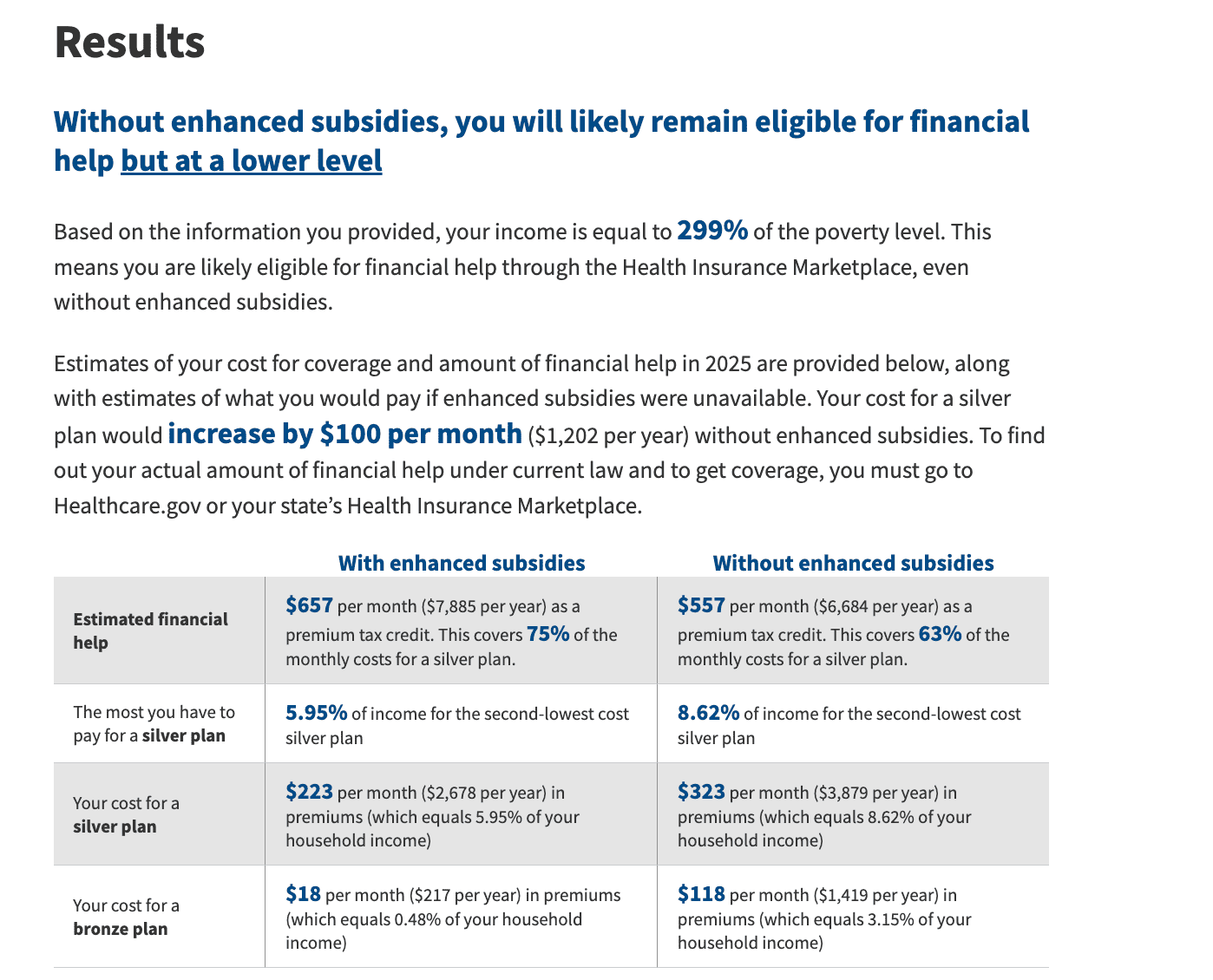
A screenshot of results saying that my income is equal to 299% of the federal poverty line. There is a graph with more details below.

An example of the results the calculator will give you.

These are the results when I put in my info: an individual living in Brooklyn, New York, with an estimated annual income of $45,000. Without the enhanced subsidies, my costs are estimated to go up about $100/month, from $223/month for a silver plan to $323/month.

One cost-crushing tool isn’t going away: For folks with lower incomes, something called “cost-sharing reductions” still exist. Those can make a big difference by lowering the amount you have to pay out-of-pocket — like for copays and deductibles.

These apply to you if you earn less than 250% of the federal poverty level. To get the cost-sharing reductions, you have to sign up for a Silver plan.

Sign-ups start November 1. Sabrina says folks who are already enrolled should get the gory details — premiums for 2026 — sometime before then. Either way, get an early start, because…

If you need guidance, you may have to wait (and wait…)

Earlier this year, the government slashed the budget for navigators — trained insurance helpers who offer unbiased information about plans in your area.

Now, with fewer navigators, it may take longer to get someone helpful on the phone. (You can, however, contact a licensed broker — but be aware that brokers get commissions from insurance companies.) So, Sabrina says get the ball rolling as soon as possible.

Unfortunately, this isn’t even close to everything

It’s not just navigators — new government regulations and the passage of the “One Big Beautiful Bill Act” mean lots more cuts — like to coverage for lawfully present immigrants, DACA recipients, and providers like Planned Parenthood.1A move that’s currently being contested in the courts.

And in years to come, there will be more paperwork required, too — pay stubs, birth certificates, etc.

But for now, you’ve got the basics. Get ready to pay more and start scoping out your options now.

If you have more questions — or insights — about enrollment in 2026, please send them our way here.

And we have a new Starter Pack with all our previous tips for shopping for insurance on our new website — including some new hustles to watch out for.

That’s all for me. Stay tuned for our next episode: My colleague Emily Pisacreta is going through this planning process right now, and we’ll bring you along for the ride.

— Claire


  • 1
    A move that’s currently being contested in the courts.

Get the First Aid Kit Newsletter!

Summing up the practical lessons we've learned about surviving the health-care system, financially.

Thank you!

You have successfully joined our subscriber list.

Reporting on why health care costs so freaking much, and what we can maybe do about it.
More about us →
First Aid Logo

First Aid Kit

Get our latest tips for dealing with the healthcare-industrial complex.

December 5, 2025

I’m getting (cautiously) AI-curious

November 26, 2025

We love the notes you send us

November 20, 2025

Choosing insurance in the worst year ever

Subscribe

Have a health care question?

For topic-specific deep dives and recommended reading, start here or use the search bar below to explore our site.

Follow the Podcast

Image

More of our reporting


Starter Packs

Jumping off points: Our best episodes and our best answers to some big questions.

Explore our Starter Packs →

How to wipe out your medical bill with charity care

Our guide to an under-the-radar but essential resource for wiping out medical debt.

How do I shop for health insurance?

Picking a health insurance plan can be super confusing. Here's our best advice.

Help! I’m stuck with a gigantic medical bill.

Don't freak out. We've laid out tips to help you manage your medical bills.

The prescription drug playbook

The high cost of prescription meds in the US is a crisis: one in four adults say they’ve skipped taking a prescription in the past year because of cost.

Help! Insurance denied my claim.

Insurance denies lots of claims, and people give up. But the majority of people who appeal win. Here's the best of what we've published so far to help you.

See All Our Starter Packs

If you don't know where to start or are just getting to know us, we recommend you start here.
Explore All

Logo for Arm & A Leg

Podcast Episodes

Our show about why health care costs so freaking much, and what we can (maybe) do about it.
Explore the podcast →
November 20, 2025

How to pick health insurance — in the worst year ever

Why it's worth looking beyond the premium and reading the fine print -- even when everything sucks.
November 6, 2025

Some things that didn’t suck in 2025 (really)

In states like Nebraska and Virginia, new laws could help a ton of people.
October 23, 2025

This health economist wants your medical bills

Health economist Vivian Ho identified a strategy for addressing high insurance premiums – one based on a real-life success story.
October 9, 2025

We love this listener’s project — and your response

A med student kicked off a collaborative project to help people avoid medical debt — inspired by the show.
September 18, 2025

Will we be able to afford insurance in 2026?

An Arm and a Leg's senior producer has to sign up for Obamacare. And it turns out, it’s one heck of a year to do that.

See the Episode Archive

One of the most enraging, terrifying, depressing parts of American life made entertaining, empowering, and useful.
Explore All

Get the First Aid Kit Newsletter!

Summing up the practical lessons we've learned about surviving the health care system, financially.

Thank you!

You have successfully joined our subscriber list.

Support Us
Contact Us
Follow the Podcast
Image
Find us on Social
  • About Us
  • Listen
  • First Aid Kit Newsletter
  • Starter Packs
  • Our Team
  • Our Partners and Supporters
  • Our Impact
  • Editorial Independence Policy
  • Terms & Conditions
ⓒ 2025 Copyright Public Road Productions
Site by Hafi
Email
Facebook
Twitter
LinkedIn
Reddit
  • About Us
  • Listen
  • First Aid Kit Newsletter
  • Starter Packs
  • Our Team
  • Our Partners and Supporters
  • Our Impact
  • Editorial Independence Policy
  • Terms & Conditions
Support Us
Manage Cookie Consent

To provide the best experiences, we use technologies like cookies to store and/or access device information. Not consenting may adversely affect certain features and functions.

Functional Always active
The technical storage or access is strictly necessary for the legitimate purpose of enabling the use of a specific service explicitly requested by the subscriber or user, or for the sole purpose of carrying out the transmission of a communication over an electronic communications network.
Preferences
The technical storage or access is necessary for the legitimate purpose of storing preferences that are not requested by the subscriber or user.
Statistics
The technical storage or access that is used exclusively for statistical purposes. The technical storage or access that is used exclusively for anonymous statistical purposes. Without a subpoena, voluntary compliance on the part of your Internet Service Provider, or additional records from a third party, information stored or retrieved for this purpose alone cannot usually be used to identify you.
Marketing
The technical storage or access is required to create user profiles to send advertising, or to track the user on a website or across several websites for similar marketing purposes.
  • Manage options
  • Manage services
  • Manage {vendor_count} vendors
  • Read more about these purposes
View preferences
  • {title}
  • {title}
  • {title}