First Aid Kit is a newsletter meant to help you fight a brutal enemy — the American health care system. Subscribe here.
How to shop for insurance, 2023 edition
Getting next year’s insurance: Some new (and updated) tips and tricks.
November 10, 2023
Share
Hey there—1
Every year, I learn some new getting-health-insurance pitfall, and this year’s is a doozy.
The title of this recent New York Times essay sums it up: It shouldn’t be this easy to lose your health insurance (gift link, no paywall).
The writer, Danielle Ofri, describes getting “an unfamiliar health insurance card” in the mail, just before New Year’s. She calls HR, figuring they’d screwed up.
“It’s not a mistake,” they tell her. “You didn’t enroll this year, so you automatically got put on the basic plan.”
… but not her spouse and kids. They’ll be uninsured.
Wait, what?!?
Yep. All her emails from HR had gotten zapped by a spam filter, including the reminders to pick next year’s health insurance plan.
After “endless phone calls” (relatable), Ofri gets her family properly re-insured, but: Duh, couldn’t her employer just default to keeping her old insurance? (And a lot of workplaces do, but…not all.)
So: If you get insurance from work…stay on top of the enrollment period this year. Check your spam filter. Check with HR. Don’t get dumped. Jeez.2
Also, if you’re on Obamacare, your plan is supposed to renew automatically. But double-check, because every year, lots of insurers tweak their offerings. The plan you get renewed into may not be exactly the same as the one you signed up for before.
Basically, the message is: Never let your guard down.
So, here’s a quick review of insurance-picking basics — condensing and updating all my prior tips into five quick points.
1. The “cheapest” plan may not be the cheapest for you (but there are some good deals, for some people).
The plan with the lowest monthly payment may cost you a lot if you actually need any medical care. Those plans heap “cost-sharing” on you, and that means more money you pay out of pocket.
However, on the Obamacare exchanges, subsidies can knock premiums down, even to zero.
Even folks with higher incomes can qualify for significant discounts. So do not assume this isn’t for you.
And if you qualify for the maximum discount — a household income that’s up to 250 percent of the federal poverty level — definitely pick a silver plan: That will come with “cost-sharing reductions” — basically zapping a lot of those out-of-pocket costs.
If this sounds too perfect, well…these subsidies are actually the exceptions to the next rule.
2. If something sounds too good to be true, it is.
Especially if you’re hearing about it from an ad. There are a lot of scams out there — including, as we recently learned from our pals at the podcast Tradeoffs, scams targeting seniors on Medicare.
Previously, I’ve advised against googling for health insurance options, because ads —some of them scammy — were usually the first results. For right now, Google seems to be blocking those ads. But I dunno. That could change.
So you may as well head right to healthcare.gov. Anything not listed there is likely to come with a bunch of really unpleasant downsides.
ALSO: We learned last year that even some companies offering plans on Obamacare exchanges can be a bad deal at any price: Like, they may not actually have doctors in-network you can see.
We got tipped off by a listener’s terrible experience with a plan from Ambetter, a subsidiary of Centene. It turned out the parent company was the target of a class-action lawsuit, accused of putting out fraudulent lists of “in-network” docs.3
Ugh. Tired yet? Um, we’re just starting. We’ve dodged the scams. Now it’s time to compare what’s left.
3. Here’s how to weed out the worst deals
Short of outright scams, some insurance plans —whether from your job, or from Obamacare — will just be a worse deal for you than others.
A very early First Aid Kit outlined a strategy for figuring out which ones are the lemons. It involves a lot of annoying vocabulary (vocab guides in the next section) and annoying math. But persist through the annoyance — pour a cup of coffee or an adult beverage, or whatever you need — because skipping these steps can end up being really freaking expensive.
For any given insurance plan, you want to figure out what you’d pay out of pocket for any health care you’ll probably need if nothing too unexpected happens next year. Just total whatever’s “normal” for you — meds, treatments for any ongoing stuff.
Then look at that same plan, and figure out: What would you pay out of pocket if you had a LOT of unexpected bills, like if you got hit by a bus or something?
And then compare the results for different plans. Some may cost you more in both scenarios. You toss those out.
Now you’re ready to choose, which means figuring out what makes you more queasy: The risk that you’ll overspend on insurance during a normal year, or the risk that you’ll get wiped out in a hit-by-a-bus year? And yes, both choices are kind of queasy-making.
4. Get familiar with some awful vocabulary.
In order to do all that math, you’ll need to get fluent with a bunch of terms: Premium, deductible, co-pay, co-insurance, out-of-pocket max (aka OOP), Rx Tiers, HMO, PPO, POS, and some others I’m definitely forgetting right now.
And we’ve got a couple of resources: I wrote a guide in a previous First Aid Kit, and YouTube legend Brian Michael Davis put together a video that’s equal parts hilarious and horrifying.
5. Get (free) help.
If you get your insurance from work, that’s pretty much where you’ll have to turn. Call HR, and don’t forget to chat up your co-workers. (You can also share this guide with your colleagues, some of whom may be picking insurance for the first time.)
If you’re buying on the Obamacare exchange — healthcare.gov — you can get help from federally-funded “assisters,” also called navigators. Go to healthcare.gov, click on “Find Local Help” and choose “Assister” under “Type Of Help.”
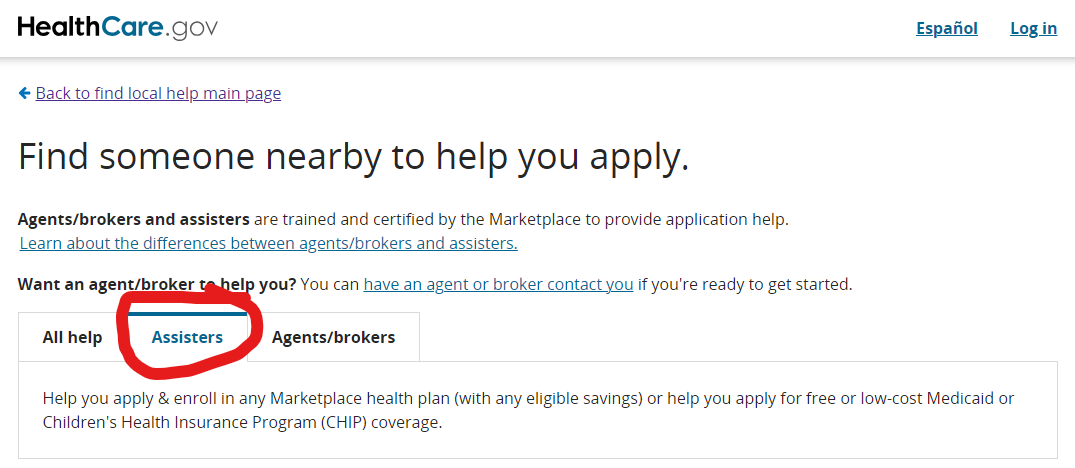
And I just learned: Assistance like this is ALSO available for folks on Medicare, via the nonprofit Medicare Rights Center, or from state-funded helpers. 4
That’s it!
I mean, that is a HECK of a lot of homework, just to get health insurance, but that is all my best advice on the topic, in one place. If you buy insurance this year, let us know how it goes. Remember, we got that tip about Ambetter from a listener. And if you want more, there are tons of links below.
One more thing
This newsletter is free, but it’s not cheap. Donations run this whole enterprise, including the Arm and a Leg podcast, and this is the best time to give.
Because right now, every dollar you give, (up to $1,000) gets matched. Your gift gets doubled, thanks to a program called NewsMatch from the Institute for Nonprofit News.
Thanks for pitching in whatever you can!
I’ll catch you here soon.
Till then, take care of yourself,
Dan
Resources
-
How to avoid picking crappy health insurance. Our first guide, part one of three
-
WTF even *is* this health insurance I’m picking? Part two of our initial guide: The vocabulary lesson. Pairs great with Brian Michael Davis’s epic YouTube explainer.
-
Buying your own health insurance? Healthcare.gov. Full stop. Part three of our first guide, on why Google is not your friend.
-
Beware of plans with “ghost networks.” Before you buy, call some docs you’d want to see and ask: Do they really take this insurance?
-
In case you want to read EVEN MORE, here’s a really long explainer from Vox.
1
Been a minute! We’ve been working on a huge investigation over at An Arm and a Leg, and it’s been soaking up a whooole bunch of time/energy.
2
Ofri also points out that a LOT of folks get bumped from Medicaid, which requires a lot of active hoop-jumping to stay signed up. (That requirement got suspended during the COVID public health emergency, and since that hiatus expired, more than ten million people have gotten bumped.)
3
The company has also settled cases brought by multiple states that had accused it of overbilling their Medicaid programs.
4
Again, a shout-out to our pals at the podcast Tradeoffs for this!
Get the First Aid Kit Newsletter!
Summing up the practical lessons we've learned about surviving the health-care system, financially.
Reporting on why health care costs so freaking much, and what we can maybe do about it.
More about us →
First Aid Kit
Get our latest tips for dealing with the healthcare-industrial complex.
Have a health care question?
For topic-specific deep dives and recommended reading, start here or use the search bar below to explore our site.