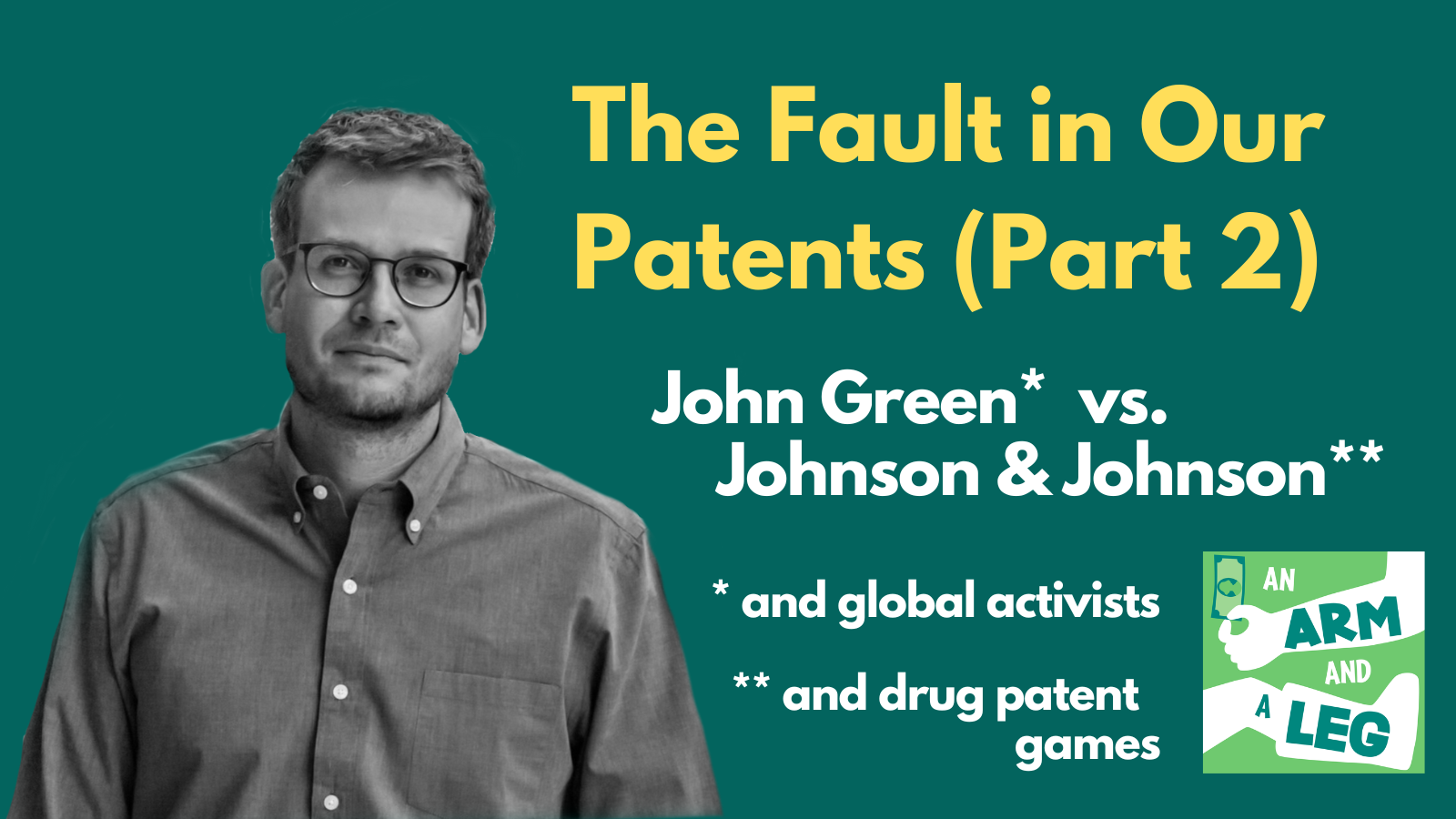
John Green vs. Johnson & Johnson (part 2)
September 28, 2023
Transcript
Share
Copy URL
This is part two of our globe-spanning story about drugs, patents, and YouTube megastar John Green.
Quick recap: In our last episode, we learned how writer and YouTube star John Green kicked up a fight with Johnson & Johnson over a medicine called bedaquiline. And appeared to score a victory.
Here, we dig into the backstory: How everything John Green and his fans won was built on activism going back 20 years, and spanning multiple continents.
All of it illustrates how pharma companies work the patent system to extend their legal monopolies on medicine way beyond the standard 20 years, and how that leads to high drug prices here and abroad.
And what we can maybe do about it.
This episode starts in 2004, when India began the process of changing its patent laws to align with global trade rules. Activists there managed to carve out exceptions to the law to prevent some of the worst patent abuses.
Fast forward to this year, when those legal safeguards become key to unlocking new doors in the fight against TB.
Meanwhile, the proponents of those Indian safeguards are here in the U.S., pushing for drug patent reform here. Which not only could help Americans, but also influence global standards.
NOTE: When originally posted, this episode contained an error regarding the countries excluded from Johnson & Johnson’s agreement with the Global Drug Facility.
Send your stories and questions. Or call 724 ARM-N-LEG.
And of course we’d love for you to support this show.
Please note that this transcript may include errors.
Dan: Hey there. This is part two of a two-part story, and although I think it’s great on its own, I also think you’re gonna enjoy it a LOT more if you listen to the first part. I’m just saying.
Here’s where we left off last time: The writer John Green — author of the mega-seller The Fault in Our Stars and unbeknownst to a whole lot of people, an absolute LEGEND on YouTube, which will become a big part of this story before we’re done — was feeling something like despair.
About drug prices: Especially the price of a particular drug — one that’s needed to treat tuberculosis in other countries, a drug that’s literally life and death for millions of people, made by — and priced out of reach by— Johnson and Johnson.
He knew that eight out of nine people who need this drug don’t get it.
John Green: this is all I was thinking about….how did we end up in a world where the world’s deadliest infectious disease is largely ignored in the richest parts of the world? but I felt powerless before it.
Dan: The drug was under patent protection. So Johnson and Johnson had a legal monopoly, and they could set the price. Even so, John Green knew there were people trying to find a way.
John Green: I would look at these activists and I would say, this is amazing what they’re doing. This is incredible. Like, I don’t understand how they have the energy to fight these fights where the chance of winning is so, so, so slim.
Dan: But he was about to find out — thanks to a successful patent challenge in India .
That patent challenge built on 20 years of legal and political work to craft the drug patent system in India.
And NOT ONLY did that challenge open the door to unlocking cheaper prices for that TB drug John Green is obsessed with
But the people who fought for those changes in India— have turned their attention to the United States for the past few years.
They think they’ve got a shot at helping us reform our own drug patent system.
And boy, do we need their help.
You might have heard— like in our last episode: One thing that makes drugs in the U.S. so expensive is the way pharma companies here work the patent system. Extending their monopolies way past 20 years, sometimes by decades.
But you know, it’s not like these global activists are here in the U.S. on a charitable mission.
They know, if we don’t get our patent act together, they’re screwed too.
Here’s the story of what they’ve won so far. How they busted John Green out of his despair, and what it could mean for us.
This is An Arm and a Leg. A show about why health care costs so freaking much, and what we can maybe do about it. I’m Dan Weissmann. I’m a reporter, and I like a challenge. So our job on this show is to take one of the most enraging, terrifying, depressing parts of American life, and to bring you something entertaining, empowering, and useful.
And the person who has really been running down this part of the story is our producer Emily Pisacreta.
Emily:.So, here’s something I learned: 20 years ago, in India, they didn’t actually recognize any patents on medicine. In fact, that’s what allowed India to build a big generic drug industry. People called it the Pharmacy of the World— cranking out cheap generic drugs.
But all that was about to change.
The World Trade Organization was tightening the screws on intellectual property, like patents. If India wanted to be part of the big global trade club, it had to agree to enforce the same patent protections as places like the US and Europe – including for drugs.
It was an interesting time to be a patent lawyer. Tahir Amin, who we met last episode, was a young one at the time, living in London— on a partnership track at a law firm.
Emily: But that wasn’t what he’d hoped for.
Tahir Amin: you know, you practice law because you feel you have a legal case and you’re using your brain to kind of find the right arguments and the best arguments.
Emily: But working for big corporate clients, with deep pockets to hire lawyers, meant arguments were … less relevant.
Tahir Amin: It wasn’t really an argument, it was just that I’ve got more money and I’m just gonna sort of, you know, railroad you into a submission.
Emily:As a patent attorney he wanted to be on the other side of that fight – maybe in a place like India, where they were creating a new patent system for drugs. By 2004, he had a new job, in Bangalore, with a group called the Alternative Law Forum.
One big issue was how India’s new patent laws would affect people with HIV. It was the height of the epidemic in India. The new laws threatened to make antiretrovirals more expensive and out of reach for a lot of people who needed them. Tahir was outraged. Just listen to him talking to a reporter back then.
Tahir Amin: you’re telling me that actually preventing such an epidemic occurring in India is not as important as maintaining the pharmaceutical industry and giving out patents on essential medicines and drugs.
Emily: So the stakes were high! And India wasn’t going to back out of its commitment to enforcing drug patents. But activists in Tahir’s circle managed to get an important concession written into the law. It’s called Section 3D. D as standing for ‘don’t try to double-dip on a drug patent in India.’ Cuz what section 3D says is basically this: if you’re gonna try and patent a new formulation of an already existing drug then you have to prove it increases the drug’s efficacy: makes it more effective.
Tahir Amin: the burden became much heavier on the patent holder or the applicant to show that it had better efficacy and that was the bridge that a lot of the, the pharmaceutical companies really did not like about in India’s law. And they still don’t like to this day,
Emily: And here’s why. People started using it. India passed its new patent law in 2005. The very next year Tahir and another lawyer founded IMAK—I-M-A-K: the Initiative for Medicines, Access and Knowledge. And in their very first year of existence, IMAK successfully challenged seven patents on HIV medicines in India. In some cases, drug companies even withdrew their patents once the challenges were filed, knowing they wouldn’t hold up.
Dan: So, for sure: getting Section 3-D was a big victory, in India, 15, 20 years ago. And let’s talk about how different it is from our patent deal in the U.S., and what that means.
Because here, like we talked about last time, drug companies file all kinds of extra patents on existing drugs— often dozens and dozens of them. A single patent lasts twenty years, but those extra patents can add years and years of patent protection — even decades. Which allows those companies to keep their monopolies, keep prices high.
Tahir Amin calls this sort of thing “over-patenting.” Other experts call it evergreening. Pharma companies have their own term: “Life-cycle management.”
And India’s patent law, section 3D, set a limit on this kind of thing. Your “new” add-on to your existing drug doesn’t make the drug work better? Sorry. No additional patent for you. You get your twenty years, then you’re done.
And TB advocates have been watching that twenty-year clock tick down on a really important drug called— you might remember from last time— bedaquiline. There are extra patents on it… that they hoped to use Section 3-D to challenge. And they wanted TB survivors to be the faces of that patent challenge.
Emily: Someone like the TB survivor I spoke to recently on Zoom
Phumeza Tisile: OK, so My name is Phumeza Tisile
Emily: Phumeza’s in Cape Town, South Africa, and our zoom connection wasn’t fabulous .
Phumeza Tisile: can we turn the video off because i think there’s a glitch?
Emily: So I’m going to relay what she told me. Phumeza first got sick with TB in 2010, when she was 19. It took a long time for doctors to realize what she had. And once they did, she had to quit university and move into the hospital for treatment for drug-resistant tuberculosis. And the treatment was rough. There were literally thousands of pills, plus lots of injections. And then one day she woke up and a nurse came by.
Phumeza Tisile: I know she was speaking. I know this because her lips were moving,
Emily: Phumeza could see her lips moving – but couldn’t hear her voice.
Phumeza Tisile: It felt like a dream.
Emily: Like about half the people given this treatment she had lost her hearing…for good. In some ways, she was lucky. She recovered from TB. And when she did, she got involved in TB advocacy, and wrote a blog for Doctors Without Borders – also known as MSF. That’s how she learned about a newer drug called Bedaquiline — a drug that didn’t cause hearing loss and a drug that had the potential to save millions of lives. Growing numbers of people have multi-drug resistant forms of TB that can’t be cured without Bedaquiline. And in 2019, MSF invited her to team up on a project to make Bedaquiline more available
Dan: … by using section 3D of India’s patent law! Because they knew: the initial patent on bedaquiline was set to expire in 2023. And Johnson & Johnson had filed one of those extra patents— a patent that would maintain their monopoly on bedaquiline for another four years.
Emily: But in India, that EXTRA patent hadn’t yet been granted. MSF saw an opportunity to challenge it based on Section 3d. MSF asked Phumeza to be the public face of that challenge, along with another TB survivor from India named Nandita Venkatesen, to make this case against the secondary patent.
That case went on for years— until March of this year. When Phumeza’s side totally won..
Based on section 3d, India rejected Johnson & Johnson’s secondary patent on bedaquiline.
Dan: And in the U.S. and around the world, John Green and other TB advocates were watching closely. They saw some big opportunities beyond India. That’s next.
This episode of An Arm and a Leg is produced in partnership with KFF Health News. That’s a nonprofit newsroom covering health care in America. Their work is terrific— wins all kinds of awards every year— and I am so proud to work with them.
AND if this story about the effort to wipe out TB speaks to you at all, you might enjoy the latest podcast from KFF: In a new season of Epidemic, Dr Celine Gounder looks at the effort to eradicate smallpox. Which a lot of people thought couldn’t be done. And which wasn’t easy.
YOGESH PARSHAR: Any outbreak was an emergency because if you don’t move within hours and contain it, you do not know how many contacts will be there, how much it would spread, and your work would increase exponentially.
Dan: But guess what? They did it. Celine Gounder talked to some of the people who actually made it happen, on the ground. Look for Epidemic Season 2, wherever you get podcasts.
So back in the U.S., John Green sees the victory that Phumeza and Nandita have won, and what it can mean. For one thing, there’s an immediate practical effect.
John Green: from that moment, that meant that Indian generic medication manufacturers, of whom there are a lot, could start to develop their Their, their own generic versions of Bedaquiline almost immediately so that like almost immediately after this patent expired in India, there would be generic Bedaquiline available in India.
Dan: And if generic bedaquiline — cheaper bedaquiline — can be MADE in India, then maybe it could be DISTRIBUTED in other countries. Johnson & Johnson would still, somehow, have to get pressured into allowing that distribution which would not be a small thing.
But the legal victory in India had just expanded John Green’s idea of what advocacy could accomplish.
John Green: And I was like, that is incredible. Like, maybe it is possible, you know, seeing these two young women who didn’t have the audience that I had or the power that I have or any of that succeed. I was like, okay, well, maybe working the system and being patient and, and, and, and, you know, fighting for incremental progress matters.
And that’s when I started to think, well, let’s see what I can do, or let’s see what we can do.
Dan: He says, “What we can do,” Because, you know we mentioned this last time: John Green and his brother Hank have millions of YouTube subscribers. And a lot of these folks are not casual viewers.
The Green brothers have spent more than 15 years cultivating an active community. They call themselves “nerdfighters.”
So Phumeza and Nandita won their case in March of 2023. And the original patent on Bedaquiline — in India, the ONLY important patent on Bedaquiline — was set to expire just a few months later, in July.
Exactly a week before that deadline, John Green posted a video that began, as lots of his videos do, in the form of an address to his brother Hank.
John Green: Good morning Hank, it’s Tuesday. So a week from today marks a huge moment of progress for human health as the patent on the drug Bedaquiline expires, allowing less expensive generic versions to be produced that can cure far more people living with multidrug resistant tuberculosis.
Dan: And then he does a quick double-take, like someone’s whispered to him from off-camera.
John Green: Wait, what’s that? Oh, well that’s unfortunate.
What will actually happen next Tuesday is that the company Johnson Johnson will begin enforcing a secondary patent, thus denying access to Bedaquiline to around 6 million people over the next four years.
Dan: The video is called “Barely Contained Rage: An open letter to Johnson & Johnson”
And in it, John Green lays out how Johnson & Johnson’s secondary patent on bedaquiline could keep generics off the market for four more years.
Keeping bedaquiline too expensive for an estimated 1.4 million people who would likely die without it.
John Green:: So if it sounds like I’m angry, That’s because I’m angry, but I think we can make change here. Thanks to lawsuits filed by TB survivors led by two extraordinary young women, there are, right now, generic Manufacturers, ready to go, making Benaquiline.”
DAN: and he urges everybody watching — and that’s a lot of people— to start making some noise. Lots of nerdfighters did exactly that.
And before the week was over, Johnson & Johnson seemed to blink. The company announced that they were striking a deal with global-health agencies, to make generic bedaquiline more widely available, beyond India.
It was a cool moment for the nerdfighters— but John Green will tell you, they weren’t the whole story.
John Green: the heroes of this story are not me or the people who watched that video, although I think our contribution was important. The heroes of the story are the people who worked for the last years to make it happen.
Dan: And as John Green says: It’s not the END of the story. For one thing, this deal excluded eleven countries— including ironically, South Africa, where Phumeza is from. All of them have high rates of TB.
John Green: the deal is good news. Um, it’s just not the news that we need yet. And everybody who it leaves out, it’s unacceptable. It’s unacceptable to leave anyone out.
Emily: And Tahir Amin says a deeper problem just doesn’t get addressed this way: It’s still Johnson and Johnson that gets to dictate virtually everything about bedaquiline – who makes it, who distributes it, and how much it should cost. That’s because, except in India, all their patent rights still stand.
Tahir Amin: yes, they’re trying to make a voluntary arrangement that can help patients get TB drugs, but the key is, is who keeps the power? And J&J keeps the power, and that’s what the real issue should be about in this conversation.
Emily: Which sort of brings us to what he’s up to now.
Tahir Amin: as an organization we’ve pivoted, um, a little bit because we, for the best part of 16 years, we, we did challenges country by country, drug by drug. And while we felt that it was very important because it, it helped tell the story and we notched some victories.
Emily: …for the last few years they’ve taken a different approach: he says 80 percent of IMAK’s work is now focused here.
Dan:. This is that really interesting turn we talked about right at the top of this episode: The global activists who have been fighting patent challenges around the world have focused their attention, their work, here in the United States. And it’s not because they feel bad for us, because drug prices in the U.S. are so wildly high, which they are.
Emily: Right. It’s because of what policies in the US mean for people around the world. The U.S. is the heart of the global patent regime. US drug companies shaped the World Trade Organization policies regarding drug patents – the policies that forced places like India to recognize patents on drugs in the first place. And it’s US patent officers who train examiners around the world. How we think about and award patents here has global implications. That’s why IMAK is here now.
Tahir Amin: what we felt was we need to educate people and policy makers, other stakeholders, other groups who are interested in these issues, basically popularize the issue
Emily: He wants to popularize the case against over-patenting, evergreening, life-cycle management, whatever you want to call stretching a 20 year patent into, say, a 38 year patent.
Tahir Amin: There’s an interesting graph that I sometimes use in my presentations. It’s like, um, you know, the duration of a patent, the social benefit actually goes up when you get the initial sort of a certain period of protection. But once you start stretching it out, The social benefit goes down.
Emily: He says not only does over-patenting keep prices super-high, it actually prevents the thing that patents are supposed to do— promote innovation: getting newer, better drugs to market faster. Because why bother making something newer and better when you have a lock on what’s selling now?
Dan: Yeah. There was a horrifying example of this in a recent New York Times story.Back in 2004, the drugmaker Gilead knew it had discovered a promising improvement to one of its HIV drugs – this new version that was less likely to damage patients’ kidneys and bones. But Gilead decided to shelve it until the patents had run dry on the old version— as part of what executives explicitly called a “patent extension strategy.”
Emily: So Tahir thinks we should rethink our patent system for drugs.
Tahir Amin: No one’s denying that people shouldn’t be rewarded for whatever investment and capital they put in. But I think the returns are just way greater than we are led to believe that they’re investing in them.
Dan: So, of course we reached out to Johnson & Johnson to ask them their opinion of these arguments. They didn’t respond, but pharmaceutical companies will often say, our ability to enforce our patent rights— the big profits those monopolies make us — is what gives us the resources to innovate, to create new medicines.
Emily: – And of course there are a lot of reasons to be skeptical of that rhetoric. For one, lots of people will point to the fact that much of the research that goes into making new medicines is actually funded by the public
Dan: Yeah, including bedaquiline. But look, getting into that debate would take a whole nother episode. Or five.
Emily: Totally. And encouraging that debate — popularizing the issue— is why Tahir’s sticking around in the United States.
Dan: Yeah— and you know, he’s fighting a GIANT battle. The scope of these battles is something I think about a lot, making this show: The systems we’re up against— and pharma is just one of them— are really big. And the solutions we need are really sweeping.
I brought that up with John Green, actually. He told me about a conversation he’d had with his brother Hank.
John Green: I remember years ago, my brother was doing something stupid like he always is. He was up to some, you know, big world changing plan. And I was like, this just isn’t gonna work, man. Like, it’s like you’re trying to move the ocean, and you have a little bucket. And you fill up the bucket, and you walk like a hundred feet.
And then you pour it in a ditch. And then you walk back. And then you fill up the bucket again. And it’s the ocean, Hank. Like, we’re not gonna move the ocean. And he was like, alright, well… Okay, but I am going to go ahead and fill up this bucket and walk 100 feet and pour it in the ditch, and then I’m going to walk back to the ocean. And I’m going to do that. And that’s just what I’m going to do. And I find a lot of beauty in that. I think a lot of times we can only see how much of the ocean we’ve moved when we look back. And for now, we go on, and we go on together.
Dan: And: What we’re talking about in this story is not Sysyphean. It’s not random activity. It’s strategic and purposeful, even if it’s slow.
About twenty years ago, Tahir Amin was in India, joining the fight to influence that country’s drug-patent laws.
And because he and his colleagues succeeded, those laws became the basis for Phumeza and Nandita’s successful challenge— which created leverage for advocates [and John Green’s nerdfighters] to use in actually pushing Johnson and Johnson to make generic bedaquline more widely available.
That fight’s not over, but guess what? The updates are not discouraging.
The pressure campaign against Johnson and Johnson happened in July 2023. As we write this, it’s September 2023, and here are three things happening this actual month:
One: The South African government launched an investigation into Johnson and Johnson for price gouging on bedaquiline and for gaming the patent system to unfairly maintain its rights to the drug.
Two: John Green and the nerdfighters teamed up with global health agencies again to blast the internet with demands that a company called Danaher lower the price of its diagnostic tests for tuberculosis.
They were like: Make this test five dollars. And within a week— literally just in time for John Green to post his next weekly video to YouTube— Danaher said, um, how about 7 dollars and 97 cents?
JOHN GREEN: which isn’t the 50 percent reduction we hoped for. but is extremely, extremely significant. And it’s significant in part because Danaher has committed to making no profit in poor countries from their standard TB cartridge.
And three: The Federal Trade Commission threatened to crack down on pharma companies for some abuses of patent system rules..
And you know who was there, egging them on? Tahir Amin.
Tahir Amin: This allows branded drugmakers to pocket extra revenue, often in the billions at the expense of Americans.
Dan: Again, all these updates are, as I’m writing this, just in the last month. Could be worse.
I’ll catch you in a few weeks.
Till then, take care of yourself.
This episode of An Arm and a Leg was produced by Emily Pisacreta and me, Dan Weissmann— with help from Bella Cjazkowski — and edited by Ellen Weiss.
Daisy Rosario is our consulting managing producer. Adam Raymonda is our audio wizard. Our music is by Dave Winer and Blue Dot Sessions.
Gabrielle Healy is our managing editor for audience. She edits the First Aid Kit Newsletter.
Bea Bosco is our consulting director of operations. Sarah Ballema is our operations manager.
An Arm and a Leg is produced in partnership with KFF Health News
That’s a national newsroom producing in-depth journalism about health care in America, and a core program at KFF — an independent source of health policy research, polling, and journalism.
Zach Dyer is senior audio producer at KFF Health News. He is editorial liaison to this show.
Thanks to Public Narrative — That’s a Chicago-based group that helps journalists and non-profits tell better stories— for serving as our fiscal sponsor, allowing us to accept tax-exempt donations. You can learn more about Public Narrative at www dot public narrative dot org.
And thanks to everybody who supports this show financially.
If you haven’t yet, we’d love for you to join us. The place for that is arm and a leg show dot com, slash support.
Thanks for pitching in if you can, and thanks for listening!
Reporting on why health care costs so freaking much, and what we can maybe do about it.
More about us →
Latest Episodes
More stories about why health care costs so freaking much, and what we can maybe do about it.
July 2, 2026
How to Fight a Health Insurance Denial With a Little-Known Tool (from ProPublica’s Paper Trail)
June 11, 2026
The Prescription Drug Playbook (Full Version)
May 21, 2026
The Chatbot Will See You Now: Big Tech In Therapy (from Organized Money)
See More
Looking for something specific?
For topic-specific deep dives and recommended reading, start here or use the search bar below to explore our site.

More of our reporting
Starter Packs
Jumping off points: Our best episodes and our best answers to some big questions.
Explore our Starter Packs →
Tell me a story about someone being awesome
It takes skills, patience, and guts to take on the health care system. We could all use a little inspiration.
Help! I’m in collections for medical debt.
So, a debt collector is chasing you over a medical bill. Here's what we've learned about what to do if you're facing debt collection.
How to wipe out your medical bill with charity care
Our guide to an under-the-radar but essential resource for wiping out medical debt.
How do I shop for health insurance?
Picking a health insurance plan can be super confusing. Here's our best advice.
Help! I’m stuck with a gigantic medical bill.
Don't freak out. We've laid out tips to help you manage your medical bills.
See All Our Starter Packs
If you don't know where to start or are just getting to know us, we recommend you start here.
Explore All
First Aid Kit
Our newsletter about surviving the health care system, financially.
Explore our First Aid Kits →
July 2, 2026
Podcast feed drop: A tool everyone needs to hear about
From ProPublica’s new podcast, Paper Trail.
June 26, 2026
New Starter Pack: People being awesome
And some bad ACA news, sorry.
June 18, 2026
Mailbag! Mysterious fees and the semantics of “charity care”
Answers to reader questions, plus introducing our new intern.
June 11, 2026
Series reboot: “The Prescription Drug Playbook”
Plus, the Supreme Court ruling about generic drugs.
June 4, 2026
Starter pack: Help! I’m in collections over medical debt
Our new resource about dealing with medical debt collectors.
See the First Aid Kit Archive
Our most useful tools for surviving the health care system, financially.
Explore All