What if this podcast were a musical? Well here’s what it would sound like.
December 3, 2019
Transcript
Share
Copy URL
Season 3 – Episode 3
Explanation of Benefits by Heckno Techno
What if this podcast were a musical? Well, this is what it would sound like.
It would sound a LOT like Explanation of Benefits, which is a musical revue that actually played in New York City in 2019. The show was created and performed by a young NYC troupe called Heck No Techno.
Explanation of Benefits is musical revue about the sad history of U.S. health care, filled with smart, funny songs.
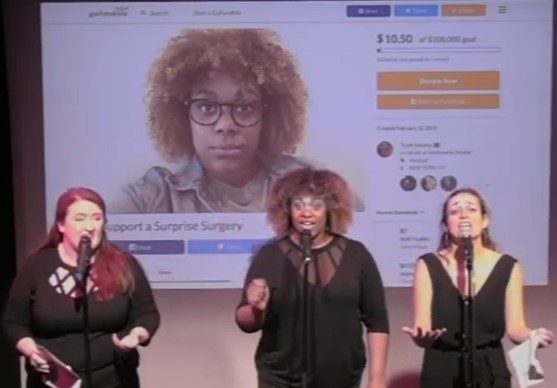
For example, it features a parody of “Bills, Bills, Bills,” the 1999 Destiny’s Child hit, rewritten for the age of GoFundMe.
Our episode isn’t sung all the way through, it’s more like the PBS documentary on Hamilton than an actual musical of its own. But that is still. Pretty. Darn. Cool.
AND: In keeping with our theme this season of self-defense against the cost of health care, Explanation of Benefits wraps with a set of short vignettes demonstrating ways patients can work to protect themselves from excessive charges.
So we have included here an email-by-email breakdown of songwriter Emily Lowinger’s successful battle to fight off a surprise medical bill.
… and we’ve set it off with music , timing and cues lovingly adjusted by our audio wizard, Adam , and it is a TREAT.
Songs from the show are up on Spotify.
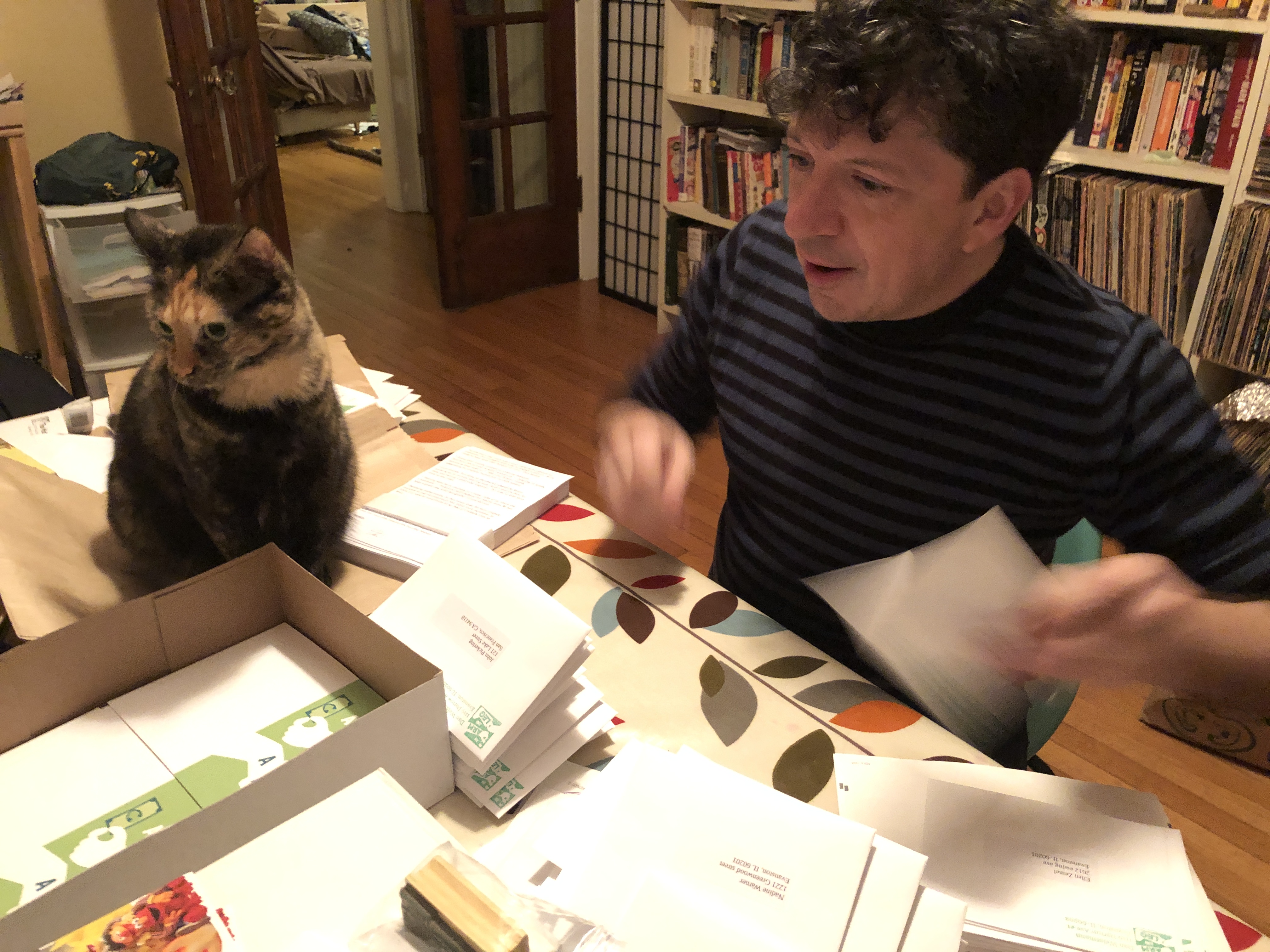
… and speaking of treats and fun experiences, I recently spent a weekend afternoon, supervised by our cat, sending thank-you cards to folks who support this show financially. I’d love it if you became one.
Please note that this transcript may include errors.
Dan: Hey there! An Arm and a Leg is supported by LISTENERS like you, through a site called patreon. If you’re digging the show, I hope you will join in. You can go to patreon dot com slash arm and a leg show— and I’ll have more about it at the end of this episode.
OK
If this podcast were a musical, it would be “Explanation of Benefits.” Which is a show that actually played in New York this year.
It does something I’ve always wanted to do on this show, which is to quickly walk through a big-picture story of how we got into our current mess over the last hundred-and-some years.
And it includes a number with this catchy chorus.
MUSIC: CAN YOU PAY MY BILLS? CAN YOU PAY MY MEDICAL BILLS? CAN YOU PAY MY DEDUCTIBLES? SO MAYBE I CAN GET MY PILLS. HAVE TO GO VIRAL OR …
There’s also advice at the end about protecting yourself from unexpected medical bills.
I mean, these are my kind of people.
(Theme Music)
This is An Arm and a Leg, a podcast about the cost of health care. I’m Dan Weissmann.
Explanation of Benefits is by a young company called Heck No techno. And they did not initially set out to do a show about the cost of health care. At all.
(Music ends)
Actually, they started out as two friends from high school, now in their late twenties — Emily Lowinger and Eileen Coneeley.
Eileen: Emily and I have been trying to write something together for so long.
There were a couple stabs at TV pilots, and then an idea for a very different kind of musical.
Emily: The idea was chastity Island
Eileen: People are on this his big brother-esque show
Eileen: The winner will be the person who stays celibate the longest, I guess. We didn’t, I should say that we didn’t ever write the show so.
Emily: But if anyone in development is listening to this— Ah we could!
Eileen: We could, we could.
It sounds pretty fun. There was a nun who was sure she was going to win. But didn’t.
But writing a whole musical was a big bite. So they were like: Let’s do a sketch show! They brought in another high-school friend — Stephanie Regina, who had been developing a career as an actor in New York.
The three of them become the group’s core. They didn’t know yet that it would become relevant to their work together, but Stephanie’s day job was… working in a doctor’s office.
STEPH: And I still go back and help out sometimes. Yeah!
They called themselves Heck No Techno, and they started developing twenty-something-type material about, like, job hunting and online dating.
But there’s this OTHER thing about being in your mid-twenties: especially being 26 or older, too old to stay on your parents’ insurance: Health care.
It kept coming up in their lives— kind of forcing itself on all three of them.
Of course Stephanie was seeing it all the time in the medical office where she worked. Both the doctors there were stressed out all the time.
Steph: in an appointment with a patient, the doctor’s mind is not able to be fully present with the patient and their issue because it’s like, okay, how am I going to code this…
Steph: you know, the amazing thing, I’m, I’m like looking back, neither of those doctors take insurance anymore
Meanwhile, Eileen had just moved back from England.
Eileen: So obviously I had had a very cushy experience with healthcare for a long time.
She came back, married to a Brit. Who’s a cancer survivor. So they needed good insurance, no messing around.
Eileen: so yeah, it was a, it was a big, big jump. We were spending a lot of money.
And Emily — the main songwriter and ringleader — was finding it overwhelming. She had left a steady job, gone freelance, and picked out one of the cheapest plans on the Obamacare exchange— which had a seven thousand dollar deductible.
She figured, OK— she was healthy.
EMILY: But then of course, something did happen. And it was—for me it was a rash. It was one of those things where it started out small and then all of a sudden like my entire back was covered.
And then her chest. It started showing up on her face.
She saw a dermatologist. Twice. On her own dime.
Dermatologist was concerned. Said, maybe we biopsy this.
EMILY: I was like, Uhhhh..
Not covered on my plan, doc!
The doc was like, Oh. Ok, well, maybe just try this cream first, see if it goes away? And it did, but the whole thing was scary.
Emily came back to the group and proposed a whole series of scenes about health care for the show they were developing.
Emily: I just felt so angry about this topic that I just remember being like, we have to do this because otherwise I don’t know what I’ll do.
Eileen: I remember when you brought it in, you said, I’ve never felt like I have to write this down or I’m going to cry.
So, they did. Eventually, it turned into a whole show of its own.
It took more than a year to develop. They’d get together to workshop material — and sometimes complain about their own experiences with the system.
Eileen: we were just having a rant and I was like, we should just all bring in our explanation of benefits and we’re going to act out the scenarios
An “Explanation of Benefits,” is that form you get from your insurance company. The one that’s really hard to understand. The one that says: “The provider says they did ABCDE, so they want to charge x, and we got discount Y, and maybe we paid it, or some of it, or whatever. You may have to pay Z. Have fun!”
And THAT became the show’s title.
But they didn’t just rant at each other. They also read up.
Eileen: we all kind of went out and did our own independent research and then came back and made each other mad.
One of Emily’s sources was one of my favorite books: An American Sickness by Elisabeth Rosenthal. (She’s editor-in-chief of Kaiser Health News, our co-producers for this show, and that book is the reason I got in touch with her. If you wanna get mad, it is perfect.)
Emily actually brought her copy — borrowed from the library — to our interview.
Emily: … So it has the stickies still in it.
Dan: Oh my God!
Emily: I’m on my seventh, um,
Eileen: renewal
Emily: renewal.
Dan: They let you do that here?
Emily: I’ve heard that you get 10. I’m testing it, you know?
[MUS: “Open Enrollment Underscore” started sneaking in under “I’m testing it…” And runs under the following narration.]
“Explanation of Benefits” had its first performance in New York in June of this year. A revised version played at the end of August.
And it’s pretty fun— we’ll have some highlights for you, right after this:
[MUS: “Open Enrollment Underscore” fades just after narration ends.]
This season of An Arm and a Leg is a co-production of Public Road Productions and Kaiser Health News, that’s a non-profit newsroom — covers health care in America. Kaiser Health News is NOT affiliated with the giant health care provider Kaiser Permanente. We’ll have a little more on Kaiser Health News at the end of this episode.
OK. The show “Explanation of Benefits” kicks off in the present— and with the personal:
With a number about a young woman picking a plan on New York’s Obamacare exchange
STEPH: 450 bucks for … BRONZE? Isn’t Bronze the worst one?
Isn’t there anything better? And by better, what I really mean is, cheaper?
There is something cheaper— Emily’s actual plan with the seven-thousand dollar deductible. The character has a back and forth with her mom.
MOM: Sure, tell me, do you have seven grand?
EMILIA: Ma, please don’t start your rants. I’ll listen to you ramble, but I get it. It’s a gamble.
In the show, that character’s gamble does not turn out super-well— starting with a kind of unpleasant rash…
But first, she closes out the debate with her mom saying, “Everybody’s got lousy health care” these days.
And here things take a turn away from the immediate. Like, a Devil character with horns enters and cackles.
DEVIL: [Cackles]
EMILIA: HAHAHHA So, why is health care so s—ty these days anyways? Let’s go back in time, shall we?
AND then the whole ensemble steps forward to answer that question with a bunch of musical numbers that turn into a kind of pocket history of how we got here. It’s like schoolhouse rock, for health care.
First up: “The Hospital Song.”
Here’s the setup: Around the turn of the 20th Century, medicine was wide-open— just about no regulation. A lot of doctors were, uh, “informally” trained, and a lot of them dispensed meds that could be poisons. Hospitals were where poor people went to die.
AND THEN…
SOLOIST AND CHORUS:
1893— John Hopkins offers advanced degrees. Where did the doctors go to train?
TO THE HOSPITAL!
X-RAYS AND VACCINES. LOTS OF NEW MACHINES MAYBE EVEN ANESTHESIA IN THE HOSPITAL
The twentieth century brings x-rays, penicillin, other improvements. Hospitals become places to get better.
And they get expensive. People end up defaulting on their bills.
In 1929, an official at Baylor University Hospital in Dallas pitches a plan to improve his hospital’s cash flow: Get people to PRE-pay, when they’re well.
CHORUS: GOTTA KEEP THAT MONEY FLOWIN — TO THE HOSPITAL.
Kimball: All right, here’s what I have in mind y’all for 50 cents a month or $6 a year, you get three weeks.
CHORUS: AT THE HOSPITAL
That’s right.
Now, that first week isn’t covered SAY WHAT? that you pay yourself. ALRIGHT And that’s what we now call
CHORUS: A DEDUCTIBLE…
That plan eventually grows up to be Blue Cross.
Fast-forward to the 1950s and 1960s and it’s a new world: New treatments. New cures. Lots of people get health insurance through their jobs. Doctors and hospitals can save more people, can do more procedures. And they can charge more:
Because: Insurance means there’s somebody to pay.
CHORUS: insurance insulates
people from the crazy rates.
The prices keep on rising…
NARRATION: In 1965 Medicare was signed into law which would provided coverage to the biggest pool of uninsured Americans: the elderly. The U S government became the biggest health insurance provider in the country.
Suddenly MOST people have health insurance. Which means there’s somebody to pay for… everything.
So there’s an economic incentive for doctors and hospitals to do more and more and more. Even, maybe, to do more than people actually need, to be healthy.
And by the 1970s, it starts becoming clear— to people who are looking— that that’s actually happening.
The show turns that bit of history into a number called Quantity Versus Quality—
It spotlights research by a guy who collected data on tons and tons of medical interactions in New England.
This is the 1970s, so there are drum machines and disco lights and cocaine spoons—
CHORUS: Quantity versus Quality, yeah..
NARRATOR There was a remarkably high rate of hysterectomies in Lewiston, Maine. At this rate close to 70% of the women in town would have the surgery by age 70 but, but that’s not all. People in one town were getting back surgery five times more often than people in another town. Same thing with prostate operations, mastectomies, hemorrhoid removals…
There’s more. Decades more.
The show covers the rise of corporate medicine in the 1980s and 90s— and drugs with gazillion-dollar price tags.
The history section wraps up with a summary of Obamacare.
And a chorus shouts out:
Obama! You saved us, right?
CHORUS: OBAMA! You saved us, right?
Narrator: NOT QUITE! While Obamacare did help to insure more Americans. It didn’t do much to cut spending or prevent predatory business practices.
Then the actors face the audience and deliver a series of first-person stories about encounters with the health care system. Some are from the performers’ own lives, others from interviews they’ve done. And of course they’re enraging and terrifying and depressing.
PERFORMER:I was sent to collections for a $25 copay.
That kind of stuff. Real cheerful.
At the end, we come back to the woman with the seven-thousand dollar deductible from the very beginning of the show. And that rash she started with has kind of taken over her face, and it’s scary, and what her insurance offers is a skype call with some random doctor.
SKYPE VOICE: press one to begin free doctor on call session with dr J.
He advises her to try performing surgery on herself, during their video call.
DOC: I’ll be with you virtually every step of the way.
We do not actually have to watch the results.
And we do get the evening’s big crowd-pleasing number…
CHORUS:
Insurance
When times get hard, you’re supposed to help me out
Instead I’m, setting up a GoFundMe account
Can you pay my bills
Can you pay my medical bills…
Can you pay my deductibles
So maybe I can get my pills
Have to go viral
Or my health will spiral
That is so fun. You can watch that whole number on YouTube.
For a coda, there’s a whole section of tips for financial self-defense, illustrated by little skits.
DOC: So what I’m going to do is, I’m going to write a little note to have you be referred for a couple of tests
PATIENT: How much do those tests cost?
DOC: Pardon?
PATIENT: How much do they cost?
DOC Ah I don’t know.
PATIENT: That’s not an answer.
DOC: Well it depends on your insurance.
PATIENT: That’s unacceptable. Go find out how much it costs.
And so on. We end with one last look at that woman with the terrible health insurance. Spoiler alert: She dies.
DOC: We need to find this woman’s next of kin! And their billing address…
…. And, CURTAIN.
After the show. the performers in Heck No Techno say that people come up to them with their own stories— and some of them super-personal.
Here’s Emily:
Emily: I think having this happen on stage, it gives people um permission in a way to just be like, yeah, this happened to me. Ah and I can tell you about it. I think that’s why they come up to us. Cause we’re like spilling our guts about all this stuff and they feel like, okay, I can too.
And not just patients. Here’s Stephanie.
Steph: The one of the doctors I used to work for came to see the show and he loved it and he said, Ooh, that was rough. Well, you know one of the things he said because he knows too, you know, he knows that like sometimes people have to look at him through a certain light in order to protect themselves and.
DAN: And that is one of the things that happens in, in that part of the show where you’re like, here’s some self-defense. I mean, it’s really like the doctor gets put in the position of like being a used car salesman basically. [inaudible]
Eileen: And that’s something we struggled with because we recognize that a lot of doctors don’t feel this way and feel trapped by the system too.
EMILY: Absolutely
They’ve got sympathy for doctors, but at its heart this is an angry show.
While Emily was helping write it, she channelled some of that anger into fighting off a surprise medical bill of her own.
A year earlier, her doctor had told her: hey, you qualify for a free breast cancer screening. And at first she wasn’t sure.
Emily: They kind of knew me at this point because I had gotten into the ritual of saying so, Hey, I’m Emily, I have this really bad plan
But they were like, yes, yes, yes. But really, this is free. She’s like OK what the hell. Takes the test. Comes back negative. Good to know.
Then, a year later, there’s a bill. More than 200 bucks.
She is pissed. Emails the doctor’s office. Email includes the sentence, “I am shocked.” Notes that they told her…
Emily: it would be covered at no cost to me. Underline. If I knew the procedure would cost me, I would have declined to get it done. I can’t pay this bill. What can be done? Best, Emily
DAN:Best.
EMILY: Yeah.
So, polite but firm. That’s 8:20 am. She follows up with phone calls. Gets told: Hey, this is from a lab that did some bloodwork. Call them.
But they’re in Utah, Emily’s in New York. She waits till their office opens, calls. They say: Hey, this is on your insurance company.
OK. She calls the insurance folks.
Emily: and they were actually super helpful.
They’re like, this one test? It’s got three codes on it. And two are preventative. They’re covered. The third one, that’s diagnostic— not on your plan.
Emily: I’m pretty sure I asked them on the phone pretty much point blank. Like, so you’re saying if the code just changes, this will all just go away. And essentially they were like, yeah, that’s what it is.
OOOOK. Now it’s the end of the day. Another email to doctor’s office. Time stamp 5:42 p.m. Explains what she’s learned, asks the doctor to re-submit so it gets coded “preventative,” not “diagnostic.”
She reminds them, the test was their idea. And they promised it was free.
Your office told me it was part of my preventative services. Can you please withdraw this and resubmit it as preventative? best, Emily.
Next morning there’s email back from the doc’s office. Hi Emily. I will forward this to the doctor and get back to you. (That’s it. No “best.”)
After a few hours, the doctor’s office sends Emily a follow-up: Hey, call the lab, the bill’s from them, here’s the number.
Back to exactly where she’d started.
Eight minutes later, 1:30 pm, Emily writes back.
Emily: I already did that
She runs down what she’s learned from the lab, and from her insurance:
Emily: the only thing that will make the bill go away is if it is re-submitted by your office as preventative best Emily.
One minute later, 1:31 pm, they respond
EM: OK. Thanks.
And then again a minute later, at 1:32
EM: I’ll get back to you.
1:33, Emily responds
Emily: thank you. Exclamation Mark.
Emily: I was trying to be, you know, chipper even though I was so angry.
And, silence.
A week later, Emily sends a follow-up. Four words: Any updates on this?
They reply ten minutes later. Yes, it’s done. You’ll get a new statement soon with a zero balance. That note ends…
Emily: Thank you for being patient with me. Have a great day.
DAN: Period? Have a great day period?
Emily: Have a great day period. I’m sure they were fed up with me, but I was so shocked. I was so shocked. It was like, I can’t believe that worked. I can’t believe that actually worked! I can’t believe I could just tell them to change the like bee bop be boop, like code thing and they just did it and then yeah 240 something dollars went away that I would have had to pay.
DAN: Ah I mean it sounds like you might’ve spent most of the day getting that done.
EMILY: Yes. And I that I, that did cross my mind like how many hours, like if I was billing a client on the amount of time it took to manage this project…
But she’s also like, whatever. I won. It’s awesome.
Emily, Eileen and Stephanie are looking to re-mount Explanation of Benefits— maybe in New York, maybe on the road, maybe both.
And they’d like to do more of these kinds of shows, about health care. They want to experiment with doing a kind of episodic series with a different bit of the health care story every month.
They say the first one will be about dental care, and how it ISN’T COVERED BY HEALTH INSURANCE. Which is weird, right? That’s gonna be called Acci-dental.
Meanwhile, they’re putting the songs from Explanation of Benefits on Spotify. We’ll put a link in our newsletter as soon as they’re up, and on twitter at armandalegshow, our facebook page, all the places.
That’s it for this episode of An Arm and a Leg.
If you are enjoying the show, please consider supporting us on Patreon. Support from listeners has made it possible for us to get here to Season 3. We are cooking up some BIG plans for next year, and we’re going to need your help.
There are fun rewards— I just sent out a bunch of hand-written thank-you cards, and some Arm and a Leg band-aids. And everyone who pitches in at two dollars a month or more gets a shout-out at the end of the show.
AND the ultimate reward is a Doctor of Righteousness diploma from Arm N Leg University. We’re getting ready to print some up — suitable for framing — for folks who give 35 dollars a month or more.
AND when we get to a thousand supporters, at any level, EVERYBODY gets one. I mean, we’re on a budget— that’s another way we’re still able to crank out the show— so a thousand people will get post-card sized diplomas. STILL EXTREMELY COOL.
It also means, we’ll be able to do a LOT more episodes. And I’ve got some other projects in mind.
I just got a mockup from our brilliant designer, Sean O’Neill. You can see it at patreon dot com, slash arm and a leg show.
Next time, mom takes her kid to the ER for stitches— they’re all out of anesthetic at her urgent care place. She asks the guy at the ER taking her insurance information— Robert— what she might pay, before she signs anything. And she says Robert’s like, umm, I dunno, but it starts at like 600 bucks. She says OK.
Except when she gets the bill, it’s not 600. It’s 2600. Actually, it’s more.
Sarah: If Robert had told me that it would be $2,600, I would’ve said thank you very much. And walked out and gone back to our lovely urgent care and been like, Cameron, bite on this stick.
Next time on An Arm and a Leg:
WHY CAN”T ANYBODY EVER TELL YOU THE PRICE UPFRONT?
Like, literally ever.
Till then, take care of yourself.
This episode was produced by me, Dan Weissmann. Our editor is Ann Heppermann, our consulting managing producer is Daisy Rosario. Our music is by Dave Winer and Blue Dot Sessions. Adam Raymonda is our audio wizard.
This season of An Arm and a Leg is a co-production with Kaiser Health News— a non-profit news service about health care in America that’s an editorially-independent program of the Kaiser Family Foundation.
Kaiser Health News and the Kaiser Family Foundation are NOT affiliated with Kaiser Permanente, the big health care provider— they share an ancestor, that’s it. It’s a fun story. You can check it out at. armandalegshow.com/kaiser
Diane Webber is National Editor for Broadcast and Taunya English is Senior Editor for Broadcast Innovation at Kaiser Health News— they are editorial liaisons to this show. And they are great.
Finally, thank you to some of our new backers on Patreon— I literally could not make this show without you. At all. Pledge two bucks a month or more, you get a shout-out right here. Thanks this week to:
Malarus, Tom, Magdalena Plewinska, Joan Allen, Mackenzie Grossgold, Rona Pietzrak, Luke Margalski, Kristie, and David Kalb.
Thank you so much.
Reporting on why health care costs so freaking much, and what we can maybe do about it.
More about us →
Latest Episodes
More stories about why health care costs so freaking much, and what we can maybe do about it.
June 11, 2026
The Prescription Drug Playbook (Full Version)
May 21, 2026
The Chatbot Will See You Now: Big Tech In Therapy (from Organized Money)
April 27, 2026
The Supreme Court case that could slow generic drugs
See More
Looking for something specific?
For topic-specific deep dives and recommended reading, start here or use the search bar below to explore our site.

More of our reporting
Starter Packs
Jumping off points: Our best episodes and our best answers to some big questions.
Explore our Starter Packs →
Tell me a story about someone being awesome
It takes skills, patience, and guts to take on the health care system. We could all use a little inspiration.
Help! I’m in collections for medical debt.
So, a debt collector is chasing you over a medical bill. Here's what we've learned about what to do if you're facing debt collection.
How to wipe out your medical bill with charity care
Our guide to an under-the-radar but essential resource for wiping out medical debt.
How do I shop for health insurance?
Picking a health insurance plan can be super confusing. Here's our best advice.
Help! I’m stuck with a gigantic medical bill.
Don't freak out. We've laid out tips to help you manage your medical bills.
See All Our Starter Packs
If you don't know where to start or are just getting to know us, we recommend you start here.
Explore All
First Aid Kit
Our newsletter about surviving the health care system, financially.
Explore our First Aid Kits →
June 18, 2026
Mailbag! Mysterious fees and the semantics of “charity care”
Answers to reader questions, plus introducing our new intern.
June 11, 2026
Series reboot: “The Prescription Drug Playbook”
Plus, the Supreme Court ruling about generic drugs.
June 4, 2026
Starter pack: Help! I’m in collections over medical debt
Our new resource about dealing with medical debt collectors.
May 28, 2026
A scary look at what’s going on with Obamacare enrollment
From our partners at KFF Health News.
May 21, 2026
New episode: The Chatbot Will See You Now (from Organized Money)
And how tech companies are sneaking into your therapy sessions.
See the First Aid Kit Archive
Our most useful tools for surviving the health care system, financially.
Explore All