First Aid Kit is a newsletter meant to help you fight a brutal enemy — the American health care system. Subscribe here.
Employer-sponsored health insurance is “unraveling”
And yes, it already sucked
September 14, 2026
Share
Hey there—
Last week’s podcast episode was a big one, tying together a big story we usually only see in fragments.
Employer health insurance — the default for 165 million Americans — is unraveling, says STAT News reporter Bob Herman. And: both the causes and the effects hit every American.
Premiums have skyrocketed. The average employer plan costs around $27,000 for family coverage.
As Bob points out, those eye-popping amounts come out of workers’ pockets. They depress our standard of living.
And because we don’t see those dollars — they’re hidden in our benefits package — the health care industry gets to feast on them.
Meanwhile, as Bob reported in July, a growing number of small businesses are giving up on health insurance entirely. And bigger employers are cutting back more aggressively than ever.
Bob joined us to unpack what he learned reporting the series Out of Pocket, Out of Reach.
It ain’t pretty. But it’s such a useful outline of the pickle we’re all in.
Keep reading here for a closer look at some of the big numbers we talk about in the episode — the parts you’ll want to forward to everyone — with charts courtesy of Bob’s colleagues at STAT News.
And if you haven’t listened to the podcast episode yet, you’ll want to, because Bob’s great company.
And: Who better to walk us through this mess than the reporter whose unflinching investigations into health care corporations recently earned him the title “UnitedHealth’s least favorite reporter”?
Insurance premiums have grown 4x faster than inflation
That’s since the mid-1980s. Yes, almost four times faster than inflation — and much faster than wages. Read the chart and weep.
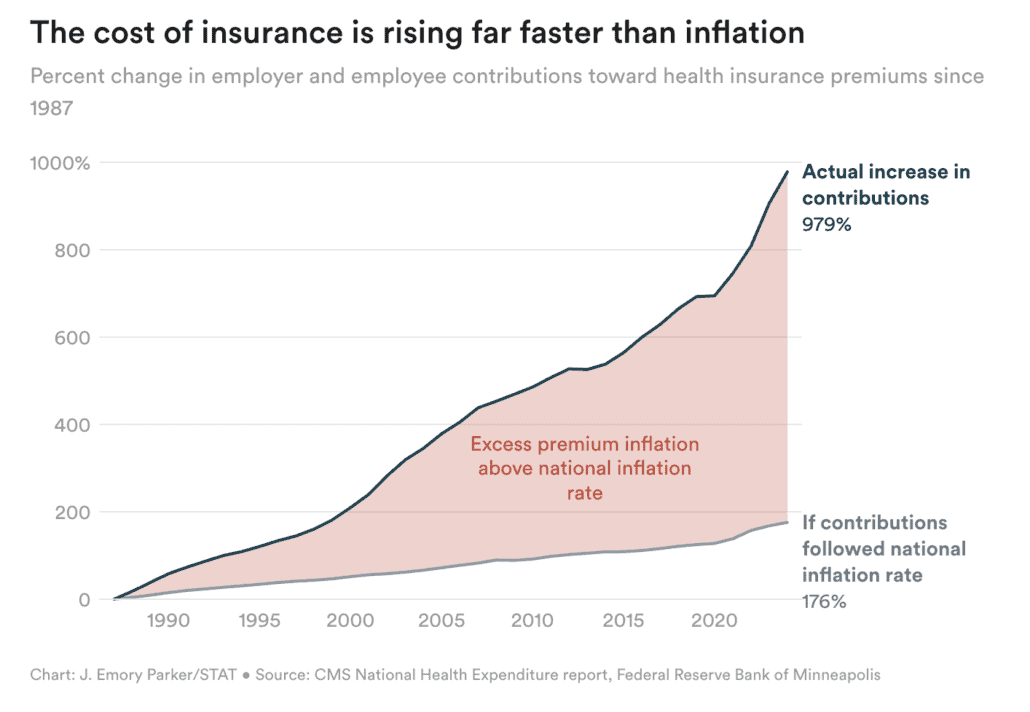
The result: Family health coverage has hit $27,000 — and that’s the average figure, not the top — about the price of a new Toyota Corolla.
For most workers, the employer picks up at least three-quarters of that sticker price.
“This big block of compensation that you get,” Bob says, “a big and growing chunk of it is for your health plan.”
Meaning…
Those dollars come out of workers’ pockets
Every extra dollar the boss pays for your insurance is a dollar they could have paid you but didn’t. It comes out of the same line on their budget, the one labeled “employee compensation.”
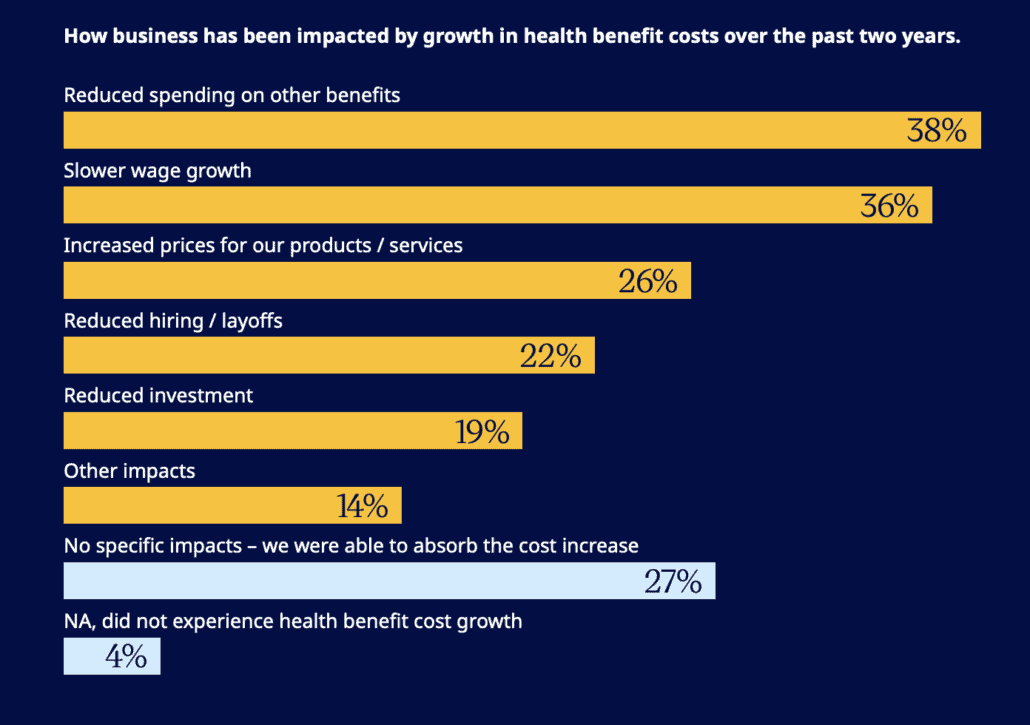
Those jacked- up insurance premiums represent a raise you didn’t get. Or a job you didn’t get, because companies cut back on hiring. Or a cut to your retirement plan. Or inflated prices you ended up paying.
Just ask a CFO. Here’s what 161 of them told the consulting firm Mercer in a survey that Bob highlighted this year:
Of course, all that money is going somewhere.
It’s going to the health care industry. That is money, as Bob put it, “that hospitals, drug companies, medical groups, everybody else, feasts on.”
With their prices hidden, providers “charge whatever they want.”
“It is to the healthcare industry’s benefit for all of us to not really understand that that money’s going to them,” Bob says.
“The commercial insurance market — what we all pay for and through our employers — that’s where they make hay,” he says. “And it’s like a feeding frenzy. They know that there’s that massive pool of money there. They could charge whatever they want.”
Bob conjures an image that’s come up before on An Arm and a Leg: “Just imagine like Scrooge McDuck, right? Where there’s this massive pile of coins and he’s kind of swimming through it. That is the employer market.”
And providers — hospitals, pharma, all the middleman entities — he says, “can really just kind of take a big claw and scoop out what they want from it.”
Instead of fighting the charges, employers cut back on health benefits
As Bob reported, an ever-increasing number of small businesses are giving up on insurance.
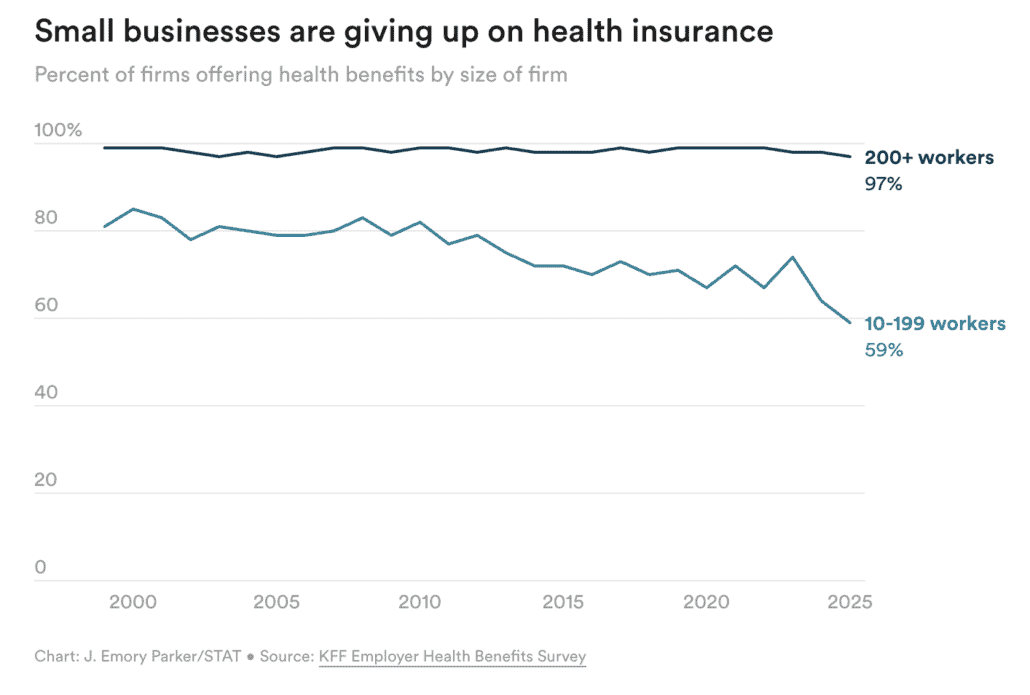
And although bigger employers overwhelmingly do offer health insurance, they keep making it worse.
As Bob and I were talking, news broke that Disney was taking an unprecedented step: Cutting off spouses and domestic partners, if they had access to insurance through their own employers.
Bob called the move shocking — ok, his actual phrasing was “batshit crazy.”
“For a company that is supposed to be very family-friendly,” he said, “this is a very anti-family-friendly thing that they’re doing.”
And an ominous precedent. “What happens if every employer did this?”
This sucks, and we need to know it
Bob doesn’t see the landscape transforming any time soon. For one thing, as much as big employers complain about the cost of employee insurance — and they do — they also benefit from it.
It helps them recruit and retain employees, and cut their tax bill. “The largest tax break in the entire code is employer-sponsored health insurance,” Bob says. “We’re talking hundreds of billions of dollars that otherwise would go into the federal kitty.”
As grim as all this is, seeing it all in black and white helps us. One of the people Bob interviewed — a small business owner who had reluctantly ended her employee health plan last year — told me she was “silently cheering” when she read Bob’s story.
Because it documented and validated her own perceptions, as she said, “that the system is fundamentally broken, and it is harming people in irreparable ways, and that we need a significant overhaul.”
As I see it: Not only is it helpful to see the big picture, it can be energizing and even empowering.
It’s good to know that we’re not alone, and not imagining things. Even if we don’t have a solution, it’s good to know what we’re all up against. All of us together.
Till next time, take care of yourself.
P.S.: Remember how a First Aid Kit reader organized a medical-debt clinic at the Brooklyn Public Library last year? They’re doing it every month now, and the next one is this Wednesday, September 16. Pass it around…
Get the First Aid Kit Newsletter!
Summing up the practical lessons we've learned about surviving the health-care system, financially.
Reporting on why health care costs so freaking much, and what we can maybe do about it.
More about us →
First Aid Kit
Get our latest tips for dealing with the healthcare-industrial complex.
Have a health care question?
For topic-specific deep dives and recommended reading, start here or use the search bar below to explore our site.