First Aid Kit is a newsletter meant to help you fight a brutal enemy — the American health care system. Subscribe here.
On avoiding a giant ER bill
Our best tips for the worst rip-off in health care.
March 31, 2022
Share
Hey there—
I said recently that prescription drugs are probably the worst part of the U.S. Health Care Ripoff Machine, but…
Emergency rooms are actually the worst.
That’s one of the first things Dhaval Bhatt learned as an immigrant to the U.S. from India. “People always told me to avoid the ER in America unless you are really dying,” he told me and my pals at Kaiser Health News.
One of the first An Arm and a Leg episodes was about why ER bills are so awful, talking with reporter Sarah Kliff, who had spent a year collecting horrible ER bills from readers.
Sarah Kliff did not find that knowledge to be empowering. She actually said she was more nervous about going to the ER after doing that reporting than she had been before.
“I’ve read over a thousand of these bills. I have no skills that would help me avoid a surprise emergency room bill,” she said.
And there is no surefire recipe for avoiding outrageous emergency room bills.
But I’ve learned a few things since that interview with Sarah, and there are a few things worth trying out.
First, though…
Diagnosis: Three Reasons Why ER Bills Are So Awful
Hospitals charge a lot for everything. Seven-dollar dose of Tylenol? Par for the course. Maybe on the low side.
Surprise bills: These are supposed to be gone, thanks to the federal No Surprises Act.
But they may not have totally disappeared, so here’s how they work(ed): Often, the doc who treats you in the ER sends their own bill. Often that doc doesn’t take your insurance, so that bill could be ANYTHING.
The new federal law is supposed to limit those charges, but as we’ve discussed, there are caveats.
Facility fees. This is a charge just for walking in the door — even if you don’t see a doctor. It can be thousands of dollars.
For instance, I talked with a woman whose seven year old got a few stitches. After insurance, she paid $214 for the doc and $2,824 in facility fees.
There’s an argument for facility fees: ER’s have fixed costs. They have to run 24 hours a day, staying ready for anything — and they have to see everybody, whether or not the patient has insurance. Sometimes, they don’t get paid. They need to cover those fixed costs, and make up for those times.
OK, but: When you look at actual bills, there seems to be serious padding going on.
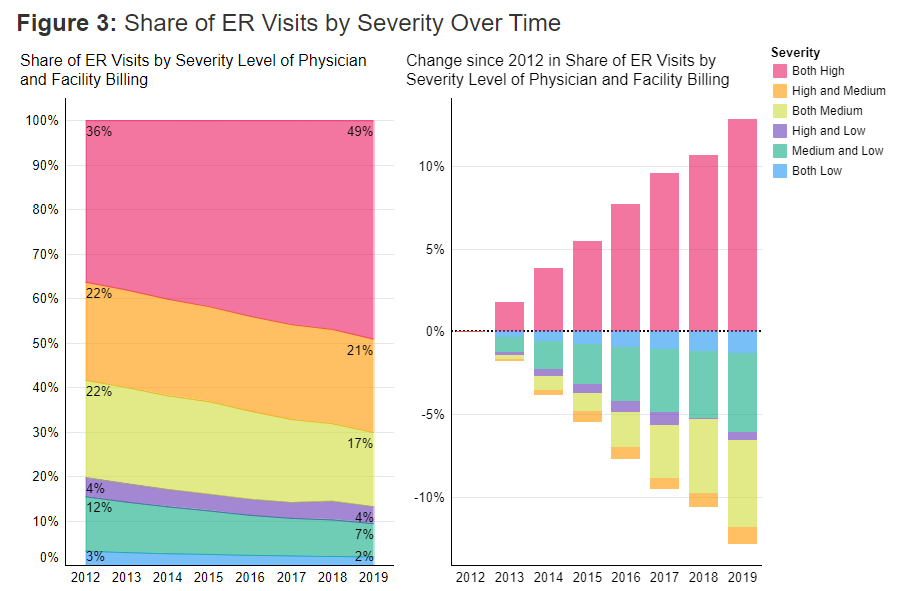
For billing purposes, every ER visit gets assigned a “level of service” from 1 to 5, based on the case’s complexity. 1 is minimal, 5 is heavy-duty.
And every year — somehow — there are fewer 1s and 2s, and more 4s and 5s, according to actual data compiled by the Health Care Cost Institute.
Take the case of Arm and a Leg listener Tom Karches. He brought his son to the ER with a terrible earache. They got a strep test (negative), a steroid to take down swelling to relieve the earache and an antibiotic.
His bill was $3,300. Of which, the facility fee was $3,100. Because the visit (for an earache) was billed as a “Level 4.”
So if that’s a level 4 — and 5 is the top — Tom wondered: “What is it when you bring in your leg in a bag?”
However: I recently had an interesting back-and-forth with a thoughtful ER doc about this. I appreciated his personal bottom line:
Docs and other ER staff don’t make the rules, don’t set the prices, and carry an impossible load.
“It often feels like we’re the only place trying to keep the whole system from falling apart, and society uses the ER for any problem at any hour,” he said.
Especially through a two-year pandemic. So, ER docs — and everybody else who works in an ER — you’ve got our thanks and respect.
Meanwhile, we still do have a problem with the bills.
So here are my best tips, for what they’re worth.
Plan ahead (when that’s actually possible)
Of course you want to avoid the ER whenever you can. And you should have a plan to avoid hitting one that’s super-expensive for you — like one that’s out-of-network, if you have insurance. To plan ahead, you want to scope out two things.
Find a place that’s not an ER… where you could be seen today. That’s in-network for your insurance plan. Like an urgent care clinic. I’ve looked up urgent-care places that are in-network for my insurance, and I, um, should have their addresses and hours written down someplace handy.
If you have a choice, figure out which ERs would be the least-horrible for you, financially: Some of them are THE WORST. Especially: Free-standing ERs in states like Texas seem to be extra-intent on gouging as hard as possible. So steer clear.
There are obvious limits to this kind of advice. Not everybody lives someplace where there are choices about where to go.
And sometimes it’s an actual emergency. You wipe out on a bike. You collapse at the office. You get bit by a snake. Whatever. In that case, freaking GO.
But sometimes you have choices, and knowing them in advance could pay off big time.
That woman who got socked with $3,000 for her kid’s stitches? She went to the ER after a local urgent-care doc told her they were out of anesthetic.
She figured the ER would be a few-hundred extra dollars, and she was willing to suck it up rather than see how loud her kid would scream during stitches.
Afterward, she wished someone at that ER told her how much it would cost.
“I would’ve said ‘Thank you very much,’” she told me. “And walked out, and gone back to our lovely urgent care and been like, Cameron, bite on this stick.”
So I’m here to arm you and give you some confidence that you can survive financially.
These are strategies for what you can do while you are at the ER.
If and when giant bills come, we’ll have battle strategies for you on that too. (We are never going to run out of material, unfortunately.)
On consenting to appropriate treatment
This tip comes from journalist Marshall Allen, who has been covering health care ripoffs for 15 years.
When he came on An Arm and a Leg to talk about his excellent book Never Pay the First Bill: And Other Ways to Fight the Health Care System and Win, we made sure to talk about what to do when you check in at the ER. It might be the most helpful tip in his book.
At the ER, there’ll be a form they want you to sign — usually called “consent to treat” — that says (a) they can do medical stuff to you, and (b) you’ll pay WHATEVER insurance doesn’t cover.
If you can, X out the part about paying WHATEVER, and instead, write this in:
I consent to appropriate treatment and (including applicable insurance payments) to be responsible for reasonable charges up to two times the Medicare rate.
Take a minute now, and copy and paste that into your phone somewhere.
You should do that, Marshall explained, because this puts you on record if there’s a dispute down the road: You didn’t give them a blank check. The treatment has to be appropriate, and the charges have to be reasonable.
And you’re citing Medicare because it pays some of the lowest rates — lower than most commercial insurance, and a lot lower than what hospitals charge uninsured people.
In bad cases, hospitals charge five times the Medicare rate or more. That’s what you’re protecting yourself from by adding this sentence.
Beware: Some hospitals have you sign on a screen instead of paper. There goes your chance to x things out.
But Marshall says he’s seen this replacement work. It’s worth trying. If you do end up writing these magic words on a hospital form, Marshall says: take a picture for your records.
Set more limits (and always ask for an itemized bill)
One of my favorite people I’ve met doing An Arm and a Leg is Shaunna Burns. She’s a 40-something mom from North Carolina who went super-viral on TikTok dishing out down-to-earth advice on medical bills.
Including: How to avoid medical bills in the first place. Especially at the ER. Here’s what she told us.
What you can say is I don’t want you to run any tests or do any procedures or anything without running it by me. And I want an itemized bill while I’m here. That’ll cut down on them charging you for stupid shit.
Taking charge of your care this way won’t come naturally to all of us — it’s a bold way to address a nurse or a doc when you’re in a medical emergency — but it’s a good idea, especially because ER’s run all kinds of “routine” tests (including pregnancy tests on people who couldn’t be pregnant).
The ER folks have their reasons — they’re usually trying to rule out whatever they can — but it’s on your dime. And it’s a lot more than a dime.
Not all news is bad news
For instance, last week’s Arm and a Leg episode features a we-love-to-see-it story:

And even when the news is a lemon, there’s lemonade: Sarah Kliff’s reporting on ERs formed the basis for one of the funniest/scariest pieces McSweeney’s ever published.
We did an audio adaptation and interviewed the author.
Of course, we also know how to make a bummer out of what sounds like good news:
But we have been taking a moment to celebrate. Last week An Arm and a Leg won a really nice award!
We’ve got a new podcast episode next week, then we’ll have another First Aid Kit.
Until then, take care of yourself.
–Dan
Get the First Aid Kit Newsletter!
Summing up the practical lessons we've learned about surviving the health-care system, financially.
Reporting on why health care costs so freaking much, and what we can maybe do about it.
More about us →
First Aid Kit
Get our latest tips for dealing with the healthcare-industrial complex.
Have a health care question?
For topic-specific deep dives and recommended reading, start here or use the search bar below to explore our site.