First Aid Kit is a newsletter meant to help you fight a brutal enemy — the American health care system. Subscribe here.
The bonus benefit in the No Surprises Act
Here's how to get some idea of what you'll be charged for a health care encounter. Plus, more caveats, of course.
February 2, 2022
Share
Hey there—
It turns out we have more rights than I knew. Last time, I ran down our new rights under the No Surprises Act — but it turns out I missed a big one.
Quick recap: The law’s main provision covers situations where you expect your insurance to cover you — you go to an in-network hospital — but somebody involved in your care sends you a wild bill that your insurance doesn’t cover. (Surprise!)
The No Surprises Act is supposed to kill that particular nightmare.
And now we’ve got more non-crappy news — a special bonus benefit under this new law. It comes with lots of caveats, but still: non-crappy.
You ready?
The ‘good faith estimate’ means you can (kind of) shop around.
That bonus benefit in the No Surprises Act can give you a sneak preview of what your bill should be before you show up for care. It’s called a good faith estimate.
In other words, it (theoretically) gives you an opportunity to shop around for less-expensive care.
And in some ways, this benefit applies in more situations than the rest of the law:
-
Unlike the main No Surprises provisions, which only apply in hospitals, this benefit applies any place you could get medical care: Your primary-care doctor, a specialist’s office, a physical therapy appointment.
-
It applies even if you don’t have insurance.
Actually, no insurance is an extra benefit and a limitation:
This good-faith estimate is for what you’d pay if (a) you don’t have insurance, or (b) you have insurance but choose not to use it.
Let’s talk about why you wouldn’t use your insurance. It’s a topic for a whole issue of this newsletter, but briefly:
-
Lots of us have insurance plans with super-high deductibles — the amount we shell out before insurance even kicks in. The average is higher than $1,000 these days.
-
As we’ve discussed before, one way health insurance actually sucks is: They do a lousy job of negotiating prices with providers.
-
… and some providers offer a “cash price” that’s lower than what insurance would pay — and lower than you’d pay if you used your insurance.
So, in some cases, not using insurance would be cheaper than using it.1
Meanwhile, this part of the No Surprises Act should give you the chance to figure out what not-using-insurance would cost in one place vs. another.
It’s not quite a right-to-shop: They only owe you an estimate once you’ve scheduled an appointment.
(What if you break the appointment after seeing the price? Could they charge you a broken-appointment fee? Ugh, I don’t know yet.)
But it does, theoretically, give you a chance to know what you’d be getting into, financially.
Also: Limits with (theoretical) teeth
Once you get that good faith estimate from a provider, there’s a limit to how much you can be charged. That was never true before the No Surprises Act.
And if somebody did give you an estimate, there was no law explicitly saying you could hold them to it.
(One lawyer I’ve talked to says we do have some rights here, but you’d have to go to court — or at least make a credible threat to do so — if you wanted to try enforcing them. Fun to contemplate, and we’ll cover the details here someday, but a bit of a project.)
Now, when you get that estimate, the final bill can’t exceed the estimate by more than $400. Anything beyond that, the provider has to eat the difference.
Somebody tries to bill you for more? Call the feds on them — because there’s a federal hotline: 1-800-985-3059.
So, that’s the good news.
OK, now the less-great news
First, there’s that $400 of wiggle room.
In the universe of medical bills, 400 bucks can be pretty small, but in the world most of us live in, 400 bucks is a lot of money.
(In fact, famously, a lot of Americans would have trouble covering an unexpected $400 expense, so the figure has an especially bitter ring to it.).
A bigger problem is that the $400 is per provider. And often there’s more than one involved.
For example, say you go for a colonoscopy (always fun). There’s likely to be:
-
a gastroenterologist, the person actually looking up your butt
-
an anesthesiologist, keeping you from feeling every little thing
-
lab tests — like if they take out polyps and want to see if they’re weird
-
a “facility fee,” which is just a random charge for walking in the door. Hospitals routinely charge these, but so do lots of other places.
-
Maybe there’s a “pre-procedure consultation” where you fill out a form and/or answer some questions. Maybe it’s with a nurse … who sends a separate bill.
OK, that could be as many as five different providers, each with their own fee — each of which could have $400 of leeway in a good faith estimate.
In other words, however high the estimate is for that colonoscopy, your final bill could be as much as $2,000 more.
Also, expect bumps on top of bumps
This is from Julia Nigrelli, an Arm and a Leg listener who wrote in recently with the email subject line I can help! 15 years in the business of BILLING. (She’s a senior consultant with a company called Chi-Matic that works on “revenue cycle management”: basically, medical billing.)
Among other things, here’s what she wrote about the No Surprises Act: “It has been a BEAST to actually implement at hospitals and most hospitals are NOT meeting the 1/1/22 deadline.”
I figured I needed to hear about that. We talked.
Julia’s main take on the No Surprises Act is: It’s great. Super important.
And: This good faith estimate is going to be hard for providers to do right.
Mainly, that’s because they’re supposed to give you this estimate in advance. Julia described it as similar to a mechanic giving you a cost estimate before they look at your car.
As she put it:
Depending upon what you present with, in the doctor’s office, you could have point-of-care testing ordered, we can order an x-ray, we could do an injection. Our estimate can go so far off, and we won’t know that until you’re seen.
I mean, I get it. So, whatever that good faith estimate says … don’t count on it too much.
In fact, the feds say in their official guidance that they expect bumps as providers start giving good faith estimates, and regulators “will exercise … enforcement discretion” this year.
Meaning: You may have limited recourse if your bill is way, way more than the good faith estimate.
One more piece of good news here
This is also from Julia Nigrelli about the good faith estimate:
If it’s from a non-profit hospital, that estimate is supposed to take into account any financial assistance you may be eligible to receive.
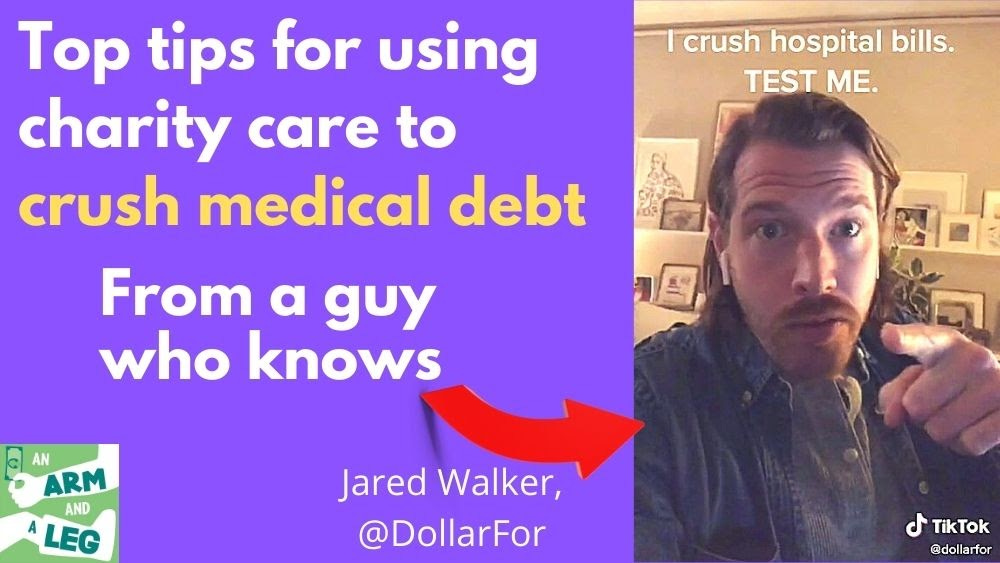
That is: Hospital financial assistance, also known as charity care. This is a callback for Arm and a Leg listeners, and a sneak preview for everyone else.
Briefly: Nonprofit hospitals — that is, most U.S. hospitals — are legally required to have financial assistance policies for folks with limited incomes. And a LOT of people can qualify.
The podcast has covered this a lot in the past year — thanks to a hero named Jared Walker — and my colleague Emily Pisacreta wrote up the practical basics here.
Here’s how it plays with the No Surprises Act: If a hospital knows you qualify for financial assistance, the estimate has to factor in that financial assistance.
If you don’t see that on your estimate: Ask to see the hospital’s financial assistance policy, find out how to apply … and see if they can respond in time to adjust that estimate.
We will come back to financial assistance in this newsletter. It’s big.
(Not big enough. And not offered often enough. But still, big. And the more people know about it, the bigger it can be.)
And of course: Still lots of crap out there
The No Surprises Act fixes just one of a kajillion outrages in our health care system — a point my fellow reporter Libby Watson made recently in her cost-of-health-care newsletter, Sick Note under the headline: Surprise! Bills still exist. (Sub-head: “A major victory is not enough.”)
Libby listed more than 20 super-outrageous, still-perfectly-legal practices — including one she says she learned about from me — so if you need a hit of rage-fueled adrenaline, she’s got you covered.
Her stuff is a reminder of why this newsletter is called First Aid Kit: I’ve learned a ton of things that can make a difference … and they’re all band-aids. Band-aids are good, they’re important. But a little outrage can be useful too sometimes.
If you want a little more, here’s a story I helped report for NPR last week:
And: If you’d like an audio version of our No Surprises Act rundown — or you know someone who would — then last week’s edition of An Arm and a Leg is just what you’re looking for.
I’ll catch you here soon. I’ve got so many band-aids for you. I want you to have them all, ASAP. Who knows which is the one you — or someone close to you — needs right now? I’ll keep them coming.
Till next time, take care of yourself.
Dan
Resources and links
-
Here’s how the feds are explaining the rules about good faith estimates.
-
Don’t forget that federal hotline for reporting violations of the No Surprises Act: 1-800-985-3059
-
Hey, Omicron’s still around. So are those fishy COVID-testing spots we mentioned a few weeks ago. Be careful out there.
-
Have you gotten your free at-home COVID tests from the feds yet? Order ‘em right here.
-
Personal note: I am looking forward to that Doctor Strange movie coming this spring.
-
And: Of course, a guy who makes a show about health care that promises to be entertaining, empowering and useful (me) would be super-into a novel that looks at how we could actually deal with climate change. And I am super, super into it.
1
You run into other problems here: When you don’t use your insurance, you don’t get closer to clearing your deductible, so your insurance stays far away from kicking in. It’s complicated, and it sucks. Again, we’ll come back to it in a future First Aid Kit.
Get the First Aid Kit Newsletter!
Summing up the practical lessons we've learned about surviving the health-care system, financially.
Reporting on why health care costs so freaking much, and what we can maybe do about it.
More about us →
First Aid Kit
Get our latest tips for dealing with the healthcare-industrial complex.
Have a health care question?
For topic-specific deep dives and recommended reading, start here or use the search bar below to explore our site.