
An actor walks into a doctor’s office…
July 24, 2019
Transcript
Share
Copy URL
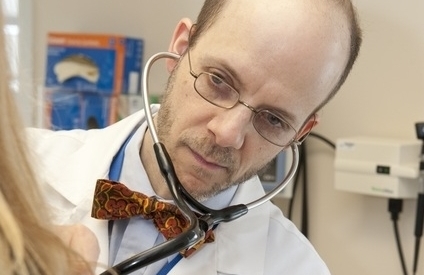
Dr. Saul Weiner is a physician and researcher at the University of Illinois (Photo: Roberta Dupuis-Devlin)
Researcher Saul Weiner has been sending fake patients, actors, wired for sound, into real doctors’ offices, to learn about what actually happens, especially: How well doctors really listen to their patients.
He’s tallied up what doctors miss (a lot), and how much it costs (ditto).
In today’s episode, we hear what actually happened in one of those “secret shopper” doctor visits, with the doctor and the actor who played his patient reading from the transcript of their visit, and then unpacking what went wrong.
Saul’s research found that most doctors were lousy listeners. And: This bad listening is expensive. And: there’s something thrilling about seeing it pinned down, so cleverly and definitively: It’s not just me. And: Jeez, it’s worse than I thought out there.

In this episode, we hear what actually happened in one of those “secret shopper” doctor visits, with the doctor and the actor who played his patient reading from the transcript of their visit, and then unpacking what went wrong. We also hear about how Saul and his colleagues are using these same techniques to help doctors become better listeners.
Please note that this transcript may include errors.
Dan: The scene is a doctor’s office about a dozen years ago.
Mark: Uh, now have you been here before?
Amy: Uh, no, I haven’t.
Mark: So what can I do for you today?
Amy: Well, I’m thinking of getting hip surgery and when I saw the hip doctor, he said my blood pressure was high.
Dan: These are the voices of the two people who were in that office. They’re reading the transcript in a studio.
Amy: Well, I’m thinking of getting hip surgery to take care of my son. So I was probably nervous about it. You know, I have been putting it off.
Mark: Uh, have you seen the orthopedist?
Dan: Well, they’re kind of the voices of the two people who were in that office, because one of them, the patient was an actor playing a role.
And when this scene originally took place, the doctor didn’t know that. The original visit was one of hundreds of times that researchers in Chicago sent fake patients actors into real doctor’s offices wired up for sound. The idea was to see what really goes on in the doctor’s office. In particular, the researchers wanted to know how well doctors really listened to their patients.
Each fake patient had a backstory, a story that if the doctor found it out would totally change their idea of the right next step for that patient. Each time the actor would drop a clue. The question was, how well are doctors catching the backstory? How well are they really listening to us?
This is an arm and a leg, a show about the cost of healthcare. I’m Dan Weissman,
and whether you think about the cost of healthcare as dollars and cents or in more human terms, this study uncovered a lot
back to that doctor’s office. The patient’s name, the character’s name was Megan, and actually we’ve already heard her drop the clue. Here it is again.
Amy: Well, I’m thinking of getting hip surgery to take care of my son,
Dan: right? So what’s the deal with her son? Deal is he’s dying in his early twenties. Muscular dystrophy, severely disabled, and she’s the only one taking care of him.
She hoists him from his bed to his wheelchair, bathes him. It’s physical. Her hip makes it tough and she hopes surgery will make that easier. Except no one’s mentioned to her that recovery from that surgery will take time, weeks, weeks when no one will be able to take care of her son. So maybe this isn’t actually the best time for her to have this surgery.
Her story is based on a real case where a woman came this close to having surgery until a doctor asked, wait, tell me about your son. Here’s that doctor.
Mark: I walked out and I was like, wow. What do we call that? I mean, that was an error, right? She got typically in healthcare, an error is like giving the wrong drug or cutting off the wrong limb or giving the wrong dose of a drug.
But in this case, all the medical stuff was right, but it was still the wrong care.
Dan: His name is Saul Wiener, and he’s the researcher who put this whole elaborate study together. He was looking for an answer to the question. How often does this sort of thing happen?
Saul Wiener: How often does care look right on paper, but is entirely wrong?
If you know the backstory,
Dan: the idea of actors playing patience. It’s not super unusual like in medical schools like the University of Illinois where Saul works. But in training situations, the student generally knows the person they’re seeing is an actor to actually send actors into doctors’ offices on real visits.
That is a lot less common and. Saul has come to think
Saul Wiener: it’s pretty important. We spend, uh, three and a half trillion dollars or so in this country on healthcare, and, uh, yet no one, no one directly measures it. Um, all of the measures of healthcare are based on what’s in the chart, what’s in claims data. So the one thing we don’t know is what actually happens, uh, during the visit.
Dan: I should mention, Saul is a friend of mine, or maybe I’m just a fan of his. The first time I had dinner with him more than 10 years ago, he told me about this research and maybe 90% of our conversations since then had been me trying to figure out ways to do a story about his work. So I was pretty excited when I got Saul into the studio with Amy Bins cavi, the actress who played the woman looking at hip surgery and the real life doctor.
She saw Mark Kushner to revisit that day in Mark’s exam room. Here’s how Mark did on that trick question.
Amy: Well, I’m thinking of getting hip surgery to take care of my son. So I was probably nervous about it. You know, I have been putting it off.
Amy: Have you seen the orthopedist?
Amy: Yeah. That’s the guy I saw a couple weeks ago to talk about it.
So, yeah.
Amy: Uh, they convinced you?
Amy: Well, I’m still weighing it. I mean, I was hit by a car in 92, so he said the top of the bone doesn’t get enough blood.
Amy: Oh. So, uh, aseptic necrosis.
Amy: Yeah. That was it exactly. So, um, you know, it’s. Just been getting worse the past couple years. I, I bought myself a cane and so I, I think the time has come.
Yeah. So
Amy: they usually say that when, uh, you decide to get the hip transplant, well the patient will come to you and request it.
Amy: Uhhuh.
Amy: Uh, they’ve gotten to the point where they just don’t want to deal with it.
Amy: Yeah, I see. Yeah, it gets bad enough and, um, I had a couple of other things to ask you while I was here,
Dan: so No, mark seems super nice, but he missed this critical clue.
He does not miss everything to a lay person like me. The rest of the visit has a matter of fact intimacy. That’s kind of disarming, but it doesn’t add up to much. Mark saw something else.
Amy: I wanted to get advice on constipation. I’m constipated. You know, I used to be like clockwork. So now it’s like every other day or every third day,
Dan: and she’s been gaining weight and her periods are heavier.
Amy: I used to be like maybe three or four pads a day, and now I find I use pads and tampons. You know,
Dan: after she mentions the periods, he suggests a blood test to check her thyroid. Before she goes, she does mention again how she’s still deciding about the hip surgery.
Amy: Imagine if I decide to do it, you know? I don’t know.
I just don’t really like to think about it.
Amy: Well, and the timing is right, you know?
Amy: Yeah. It’s, it’s a big decision,
Dan: but he doesn’t probe any farther and she doesn’t bring up her son again.
Amy: Uh, any other questions or anything?
Amy: No, I think that’s it. We talked about mostly I wanted to not forget the constipation.
We talked about that, so that’s good.
Amy: Okay.
Amy: Alright, cool. Um, I’m pleased about my blood pressure.
Amy: Yeah. It seems to be all right.
Amy: Yeah, that’s good.
Dan: And scene. Well done you guys. I’m totally gonna cast you in these parts. Yeah, you’re perfect. We made the audition. Yeah, you totally passed the audition. That’s great.
Amy: It’s, it’s so funny ’cause reading this, I remember I so wanted you to get that clue. I, I, I, and I feel like I almost cheated a little at the end. ’cause we were only supposed to save once. I wanna take care of my son. Oh, you, you weren’t
Amy: allowed to bring it back up?
Amy: No. If they didn’t pick up on it. But then at the end I was like, oh yeah, it’s a tough decision.
’cause I, I remember now reading this, I really liked you and I wanted you to get the clue, but I was thrilled that you got the thyroid.
Dan: So yeah, there was a second puzzle and this is the part that Mark got right. In addition to dropping a clue about a personal backstory, each fake patient throws out a few clues to a biomedical issue that you’d want a doctor to pick up on.
In this case, that was all the stuff that seemed random to me. Constipation, weight gain, heavy periods. To mark those three things together meant a let’s get a blood test to check your thyroid, which was the right answer. Saul says, missing the personal story clue, but picking up the medical clues was how it went in a lot of these fake patient visits.
Saul Wiener: And we just found that physicians tend to have a bias even though both of them were set up. So they’re really critical. Physicians tended to have a bias to hone in on the on, on the biomedical.
Dan: Amy, how times did you play this case?
Amy: Uh, about 50,
Dan: 50 times. Yeah.
Amy: 40 to 50. I can’t remember.
Dan: Yeah. How many times did the doctor say like.
What’s this about your son?
Amy: It was really interesting. Um, there were only a, a couple that went all the way through and recommended not getting the surgery. There were, uh, several who, uh, found out the situation with my son. Hmm. Um, found out that I was a sole caretaker and still recommended the surgery. No kidding.
So it was a little, uh, it was a little, it was a little distressing for poor Megan. Yeah. Yeah. I think there were, there were two or three that. Went ahead and said maybe you shouldn’t get the surgery, and, you know, let’s, and referred me to social workers to try to get me some respite care. Wow. I even have one where, uh, the physician said, what’s up with your son?
And I was, oh, he’s dying. You know, I’m the only one taking care of him. Oh. Do you have any family history of high blood pressure? It, it, it was like not even a, not even a touchy feely moment. It was a little, uh, it was a little jarring. Wow.
Dan: How did it feel?
Amy: Um. It was very frustrating to lay out this scenario and then see that opportunity just go by for the physician
Dan: for his part.
Mark definitely recognizes he missed something big here.
Amy: I think Saul is right about, you tend to concentrate on things. You can do something for, you know, I can handle constipation, I can handle these other medical problems really easily, and I have solutions. The other things are more difficult to deal with now.
You should be noticing them, but maybe just in not even thinking about it, you just kind of. Tend to steer toward the more concrete things that you can actually help. Uh, right now with I,
Dan: I’m guessing that’s, it’s like part of your training being a doctor as part of what you’re, that’s, that’s the job.
Amy: Well, yeah, it is, but it’s also, you know, part of the training that you need to pick up on.
Emotional clues and you know, you know, they don’t always tell you everything.
Dan: Yeah. And one of the things that I think of when I hear about this is also that you’re under, like, you’ve got a certain number of patients you gotta see every day. You got checklists to fill out, you know, which isn’t to say that you become an impatient person, but just, I mean, I imagine it pushes you a little bit away from the like, sit down, have a cup of tea.
Tell me about your family. Right. I mean, it’s not that kind of visit. What I’m trying to say is it just seems like the most obvious reason doctors don’t ask a lot of follow-up questions is they’re pressed for time, but Saul throws a real curve ball here. That’s right after this break,.
An Arm and a leg is a co-production of Public Road Productions in Kaiser Health News. That’s a nonprofit newsroom covering healthcare in America. Kaiser Health News is not affiliated with a giant healthcare provider, Kaiser Permanente.
We’ll have a little more on them at the end of this episode. So Saul says, yeah, doctors are concerned about time, but time
Saul Wiener: isn’t really the problem. Physicians often feel, wow, you know, this patient just said. I’m looking forward to taking better care of my son and a man. If I ask, ask them about that, I’ve just opened up a Pandora’s box and it’s gonna derail the conversation and we’re never gonna get done.
That’s, that’s what goes through your head. And yet what we found is that the physicians who did that did not, on average, have longer visits. So then we asked ourselves how could that possibly be? And what we discovered is, was because they saved a lot of time on the backend and then there was no discussion of all the stuff related to the wrong care.
Amy: So if you have a patient that says, you know their, let’s say their diabetes is uncontrolled, and they at some point say, yeah, I’m not taking my insulin. And if the provider then. You know, gives them a lecture. You should be taking your insulin. But if they say, why aren’t you taking your insulin?
And then the patient says, and we’ve heard this, well, my mom has diabetes and she doesn’t have insurance, so I’m splitting my insulin with her. Then all of a sudden you understand what the problem is and it’s much easier than to address it. That as opposed to every visit, they’re coming back and the diabetes is still uncontrolled and they haven’t figured out what is exactly going on.
Dan: And you’re skipping the lecture.
Amy: Yeah. You’re skipping the lecture.
Dan: Exactly. And here’s the other thing about asking more questions and giving the right care. It was cheaper. For example, there was a character, and these are all based on real cases, older guy losing a lot of weight.
Saul Wiener: When he came in to see physicians, he would drop several clues that he was experiencing homelessness and that he was food insecure, meaning that he basically couldn’t get a solid meal and more than half of physicians.
Would latch onto this problem of unexplained weight loss and think about cancer, and they would order a colonoscopy and a CT scan and all kinds of things that you think about when you’re worried about someone having cancer. And it was only a minority of physicians who would pick up on the clues that there was a major.
Psychosocial problem and that basically he was hungry. And when they picked up on that, obviously they didn’t order the big cancer workup and they got a Meals on Wheels and social support and we saw obviously a big difference in cost there between those two decision points.
Dan: Cat Cat Scan versus Meals on Wheels.
Saul Wiener: Absolutely huge difference, dude.
Dan: Saul and his research partners have tallied up the price of all the bad care that got ordered in these fake patient studies. The CAT scans where Meals on Wheels would’ve been the right call. The way they do the math when you add up all that unnecessary, unhelpful care.
It adds hundreds of dollars to the cost of the average doctor visit real money, and that is not counting how much more expensive it gets to treat things correctly if you miss them. The first time that malnourished patient ends up vulnerable to pneumonia, winds up in the er, hospitalized, and it doesn’t count the suffering.
The woman who got the surgery and then had no one to take care of her son.
As we talk about all this, I find myself looking at poor Mark who’s actually being an incredibly good sport. And Mark, I’m sorry, I feel like I’m looking at you like, and the doctors didn’t think about it as if you personally are embodying all the doctors who kind of missed all these clues.
Mark: Well, the thing that bothers me is that, uh, in retrospect, this was the main thing that was bothering her.
I mean, she had a bad hip. She’d had that. But this was the main question on her mind, the main problem, and I didn’t catch it. So that that’s bothersome.
Yeah. Well, don’t feel too bad.
Okay. She’s okay. Here she is, 13 years later, smiling at you. She likes you
Amy: and her thyroid is fantastic. Oh, great. Yeah, yeah, yeah.
Dan: No, you succeeded. Do you have any questions for these guys now that you’ve been through this?
Mark: Oh, no, not at all.
Amy: I wanted know, did you suspect I was a fake patient?
Dan: I didn’t. No.
Amy: Yay.
Amy: No, you were very good.
Dan: I ask Amy how doing this work has changed her perspective.
Amy: Before this, I would’ve thought that.
Physician communication skills were more about empathy and hugging and touchy feely, and I’m realizing now, no, it’s, it’s listening for things that are actionable. Like the physicians that would find out that my son was dying and would, you know, maybe hold my hand and be very empathetic and I’m so sorry for you.
But still recommend I get the surgery. Doing all this work has really honed my idea of what efficient communication is between a patient and a doctor.
Dan: These days, Saul and his colleagues, including Amy, they’re still working together, use these same methods to help doctors do a better job. For that. They send in hidden recorders with real patients, and then they analyze the results and give feedback to the doctors.
They work with whole practices. Everything’s de-identified so that nobody’s having a finger pointed at them personally. We just basically
Saul Wiener: keep showing the doctors what they missed. Uh, we also, by the way, show them what they got. Right. We, we don’t wanna just make ’em feel bad. We show them everything. Um, but we found that that process of just.
Showing them, and it’s so real because it’s them that that tends to heighten their attention and we’re seeing that that’s slowly tipping them towards better care.
Dan: Wow.
Next week on an arm and a leg, we visit a clinic in a poor community in Goshen, Indiana, where attending to people’s stories is one of the top priorities.
Medical Care Organizer: We had a board member recently say, really we are not. A medical organization, people think of us as medical organization. We’re not. We are fundamentally a peace and justice organization that happens to be engaged in our community through medical care.
Dan: It sounds impossibly pie in the sky, but they have impressive results to show for it. Hard data on a tight budget. It’s a fascinating place. I cannot wait to bring you there next week. So then. Take care of yourself. This episode was produced by me, Dan Weissman. Our editor is Whitney Henry Lester. Our consulting managing producer is Daisy Rosario.
Our music is by Dave Weiner and Blue Dot sessions. Adam Raimundo is our audio wizard. Our intern is Daniel Fernandez. This season of an arm and a leg is a co-production with Kaiser Health News. It’s a nonprofit news service about healthcare in America. It’s an editorially independent program of the Kaiser Family Foundation.
Kaiser Health News and the foundation are not affiliated with Kaiser Permanente, the big healthcare provider. They share an ancestor. That’s it. It’s a fun story. You can check it out at arm anda leg show.com/kaiser. Diane Weber is National Editor for broadcast, and Tanya English is senior Editor for Broadcast Innovation.
Kaiser Health needs. They’re editorial liaisons to this show and they’re great people. Finally, thank you to some of our new backers on Patreon. I literally could not make this show without you. Pledge two bucks a month or more. You get a shout out right here. Thanks. This week to Daniel Fox, Karen halting, David Willhoff, Ryan O’Hare, Becky Friedman, Trina Dam, Peggy Saluki, David Hoffman, Daniel Squees, Jessica Tate, Zamber Pap, and Erin Parker.
Thank you so much.
Reporting on why health care costs so freaking much, and what we can maybe do about it.
More about us →
Latest Episodes
More stories about why health care costs so freaking much, and what we can maybe do about it.
September 24, 2026
Medicare plans keep disappearing
September 3, 2026
System meltdown: employer-sponsored health insurance
August 13, 2026
A Texas doctor’s love letter to ‘The People’s Hospital’ (From 2023)
See More
Looking for something specific?
For topic-specific deep dives and recommended reading, start here or use the search bar below to explore our site.

More of our reporting
Starter Packs
Jumping off points: Our best episodes and our best answers to some big questions.
Explore our Starter Packs →
Why do prescription drugs cost so much?
It’s a national outrage — one that millions of us struggle with: the unaffordable price of prescription drugs. Here’s our reporting on how drug prices got so out-of-control, and what we can maybe do about it.
Tell me a story about someone being awesome
It takes skills, patience, and guts to take on the health care system. We could all use a little inspiration.
Help! I’m in collections for medical debt.
So, a debt collector is chasing you over a medical bill. Here's what we've learned about what to do if you're facing debt collection.
How to wipe out your medical bill with charity care
Our guide to an under-the-radar but essential resource for wiping out medical debt.
How do I shop for health insurance?
Picking a health insurance plan can be super confusing. Here's our best advice.
See All Our Starter Packs
If you don't know where to start or are just getting to know us, we recommend you start here.
Explore All

First Aid Kit
Our newsletter about surviving the health care system, financially.
Explore our First Aid Kits →
September 24, 2026
Medicare is in worse shape than we thought
And we thought it was messy before
September 14, 2026
Employer-sponsored health insurance is “unraveling”
And yes, it already sucked
August 13, 2026
It’s always been a fight — and maybe a joy
Revisiting ‘The People’s Hospital’ and reading Ross Gay
August 7, 2026
New starter pack! Why do prescription drugs cost so freaking much?
And what our summer intern learned about the cost of gender-affirming care.
July 23, 2026
New episode! Veteran health reporter Julie Rovner is back
And she's worried.
See the First Aid Kit Archive
Our most useful tools for surviving the health care system, financially.
Explore All