
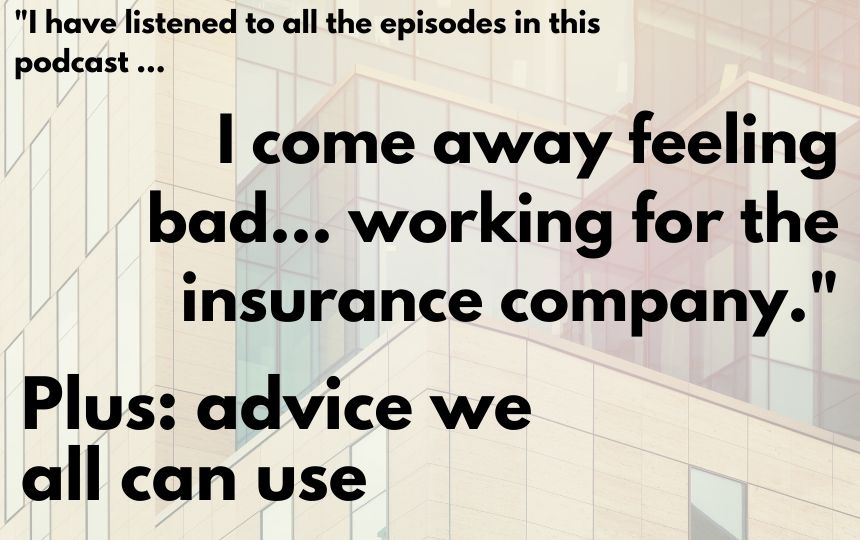
From inside the health insurance company: Angst, and advice we can use.
May 13, 2020
Transcript
Share
Copy URL
A listener, who has worked in health insurance for decades, wrote in after a recent episode. “I have listened to all the episodes in this podcast, and there are times I come away feeling bad working for the insurance company,” she said.
We talked. In addition to angst, she shared insights and advice we all can use.
Please note that this transcript may include errors.
Dan: Hey there. I’ve been asking you to chime in — send us stories, send us questions— and you’ve been coming through.
A couple weeks ago, we had the story of Anna Davis Abel’s fight to get her insurance company to pay for a test she got because she and her doc thought she might have COVID-19.
In public, the company was saying, “We’ll pay for this kind of stuff 100 percent.” But they told Anna, “Nah, this 500 bucks and change? It’s on you.” [At least that’s what they said until reporters got involved.]
I asked folks who’d had a similar experience to get in touch.
What I GOT was a note from a woman who said she’s worked for a big insurance company for decades.
Her note said: I just finished listening to this episode and have to say that I am shocked. … I understand Anna’s frustration with what happened, believe me, I would be screaming from the roof tops if it were me.
She also said: “I have listened to all the episodes in this podcast and there are times I come away feeling bad for working for the insurance company.”
And she had some advice for all of us, based on things she’s learned from working for the insurance company.
So I called her up.
In her note, she’d said I could use her full name— as long as it was clear she didn’t speak for the company— but when I asked her what she did there, she hesitated a little bit… and then she was like
Kim W: I investigate healthcare fraud.
Dan: Oh, wow.
Kim W: So you want to pick my brain is what you
Dan: Yeah. Right. Yeah. Absolutely. Absolutely Yes.
Dan: We were on the phone for an hour. I’m not gonna use her full name. Get ready for some highlights.
This is an Arm and a Leg, a podcast about the cost of health care. I’m Dan Weissmann.
I should say, my talk with Kim wasn’t full of blockbuster revelations: YOU’LL NEVER BELIEVE THE SCAMS
I mean there WERE some insights. Stuff I think will be really useful.
But it was also just really interesting— and useful in its own way— to hear from someone deep inside the machine. Someone who wants to be an ally.
First, we talked about how it felt to her, hearing our story about Anna Davis Abel, and her fight over that bill for testing.
Kim W: if it was me, I’d be screaming to high heaven
Dan: I mean, Kim has a little — call it empathy for the company. Basically, she says, at the company where she works, they got caught flat-footed by the pandemic, like everybody else.
Kim W: It’s different when you see. Earthquakes, or hurricanes or natural disasters you see that, so you, you have practices in place, because we’ve already gone through this, whereas now you have a virus the whole world is shut down for this virus. And we’re trying to put things in place as well as taking care of our employees who may be affected as well.
Dan: In other words, they didn’t really have a playbook. They’re playing catch-up— AND everybody’s figuring out how to do their jobs from home. It’s a mess. Balls are gonna get dropped.
Of course, when they get dropped on YOU, it that can be a huge deal— like a change-your-life kind of deal. And it’s totally wrong.
Hearing Anna’s story on our show brought that home for Kim.
Kim W: the $500 was a hard hit for her and knowing that there’s other people out there, my next door neighbor is losing her house because of her medical bills and she’s had to file bankruptcy and they foreclosed on her home. It’s so close and to see it and knowing that you know, your insurance is part of it. It just eats at my soul.
Dan:So, I asked Kim: What about the advice she had? In her email, she said, watch those bills. Go over ’em. A lot of the time, they’re wrong. We’ve heard this advice before, and here it is again.
It’s advice she gives people in her own life.
Kim W: Family members and stuff, and they’ll look at, you know, those come to me and they’re like, okay, you, you understand insurance, what’s this? And I’m looking at it going, well, did you have this procedure done or not like that? Or never? I’ve seen some where people are like, well, I can’t understand why I’m paying $25 for a Tylenol, and I don’t remember having the Tylenol.
She’s like: Get an itemized bill. And if there’s anything on it that seems questionable— like, did it even happen? — call up the provider and ask.
Kim admits, there’s no guarantee they’ll play ball with you. Which sucks.
But I have heard your testimony, and I can tell you: It is a hundred percent worth trying.
Sometimes they’ll offer to take weird charges off right away.
Other times— if they don’t — and if you’re ready to do battle, that itemized bill gives you ammo.
Last year, in an episode called “Can They Freaking DO That?!?” we walked through the steps of fighting a legal battle— using small claims court. You don’t have to be a lawyer, and you don’t need to hire one.
And a lot of times, just the threat of using small claims court — if you do it right— is enough to get a better deal. (If you haven’t listened to that episode, go check it out.)
But not everything is a candidate for that. Like, some bills are too big for small-claims court.
And I asked Kim: what if it’s your insurance company that’s leaving you on the hook for something that seems totally wrong?
And this is where things got real. And where I learned stuff. About what we’re up against, and how to take your best shot at protecting yourself. That’s right after this.
Dan: [00:06:10] This season of An Arm and a Leg is a co-production with Kaiser Health News. Kaiser Health News is an independent newsroom reporting on health care in America. It is not affiliated with the giant health care provider Kaiser Permanente. There’s a little more detail on Kaiser Health News at the end of the show.
So, I asked Kim: What about when your insurance company seems to be leaving you on the hook for stuff that just seems WRONG?
KIM: Yeah. That’s where you hope. I hate to say this, I really do. This is where you, how did the person on the other end of the line when you’re calling the insurance company is diligently listening to you .
And she says, you’re hoping for some empathy there. And here’s one of the hard parts— that makes her say, “I hate to say this…” A lot of the time, the person you’re talking with isn’t even in the United States. It’s cheaper to hire a call center in another part of the world.
And that creates a problem— a barrier to understanding— that I hadn’t really thought about. When people call customer service and talk with someone in another country…
Kim W: they’re getting. People who don’t understand they don’t understand health insurance because maybe one, they have universal healthcare or two, they don’t have healthcare at all that they have to pay out of the pocket and stuff like that. So they, they don’t, they can grasp it. They can’t grasp the, the novelty of health insurance.
Dan: They don’t have personal experience. . They only kind of know what they get from their training.
Kim W: Correct.
Dan: And the kind of directives from the company. So they, so that I, that ability to, to have to, yeah. To have empathy. It’s, it’s, they’re limited just because they lack some of the experiential basis for that empathy.
Kim W: Yes,
Dan: Kim says she has advice for this situation. Basically, to start with, get ’em to take it slow— one step at a time.
Kim W: Just tell them, you know, tell them I’m sorry, I’m not understanding. Break it down for me.
And then of couse there a next step…
Kim W: You know, escalate it up.
Dan: Escalate it up. Say, “You know, I think I’d better talk to your supervisor.” Kim says at her company, when you’re transferred to that supervisor, the call can get routed to someone in the U.S.— someone who’s maybe had the experience of calling their insurance company, of getting a weird medical bill themselves.
Of course, even when you get someone in the U.S., you may not be reaching a sympathetic ear.
Kim W: Yeah, I mean, it’s like with any human nature, you could, um, you may be having a bad day, and unfortunately it’s reflected on the call.
Dan: That is, the person you’re talking to could be having a bad day. And then, however their day is going, there’s the reality of their job.
Kim W: You know. it, it is a high volume. They have stats that they have to meet. Like with any call centers. They have stats that has to be met as far as the inbound calls are being taken.
Dan: Meaning, it’s their actual job to get you off the phone fast, so they can take the next call, and keep up with those stats.
Kim W: And a lot of times, you know, you feel like you’re being rushed off the phone. And that happens to me as well. Um, when I’m calling
Dan: you, when you’re the person who’s got the medical bill that you need,
Kim W: Right?
Dan: Wooow. I mean, it’s not the MOST encouraging thing I’ve ever heard. The person with the most understanding of the situation, who works for the insurance company, has for decades, says SHE gets the bum’s rush sometimes.
But it’s reality. I texted Kim later, asked: What do you do when that happens? She wrote back:
“I take a deep breath and take control of the conversation. I understand their need to move on to the next call, but if my questions are not being answered, I tend to rephrase them so that I can get the information I need. I’ll say, ‘So let me make sure I understand what you’re telling me…” dot dot dot
We all know none of this is guaranteed to work. Even if we can get the other person to slow down, to be reasonable— a lot of the time, the rules are not written in our favor.
But do it anyway!
Because, Kim knows the rules. She’s been working on the insurance side for decades. And even she needs to take deep breaths and slow the conversation down.
Note to self: I should probably bring somebody on this show who can teach us all how to meditate in the moment.
I asked Kim how she started listening to the show.
Kim W: My therapist is the one who told me about your podcast.
Dan: Is this is something I’ll make you feel better.
Kim W: Exactly.
Dan: Have you, have you brought it back here and said like, why don’t you have me listen to this? Or what have you? Have you have you, or have you discussed it?
Kim W: Well, no, I haven’t discussed it because, you know, um, couldn’t the sand during the virus. And, um, so I’ve got a scheduled meeting with him soon, but yeah, I’m just going to go. Okay. Why? Just adding to my anxiety.
Dan: I, I’m, I mean, I’m so glad you’re listening. I’m so glad you got in touch. Um, you know, I really appreciate it.
Kim W: Oh, no problem. It just hit me. knowing that she had to fight, and anytime that I, you know, I hear that, you know, last season where, you know, they’re fighting spills and stuff like that, and I’m like, you know, why is it such a battle? Why, why, why is it such a battle?
Whereas my father showed me how much it costs for me to be born. Yeah, $250 and that’s everything. The hospital bill is my delivery, my doctor, everything just to deliver me back in 1962 but that’s not the case these days to deliver a child, even if it’s just a, you know, in and out. She goes, she actually delivers the child.
She’s out the next bed you’re looking at, you know, a couple of 15,000 to $20,000 this is a syllabi bill. And it’s like, why? Why is it that much for a woman to go in to have this child?
You know? Why is it that much? Why
Dan:You’re one of us. think, I think, I think basically we’re all one of us. Yeah.
Kim W: Yeah, exactly. Well, you know, and I’m not the only one in the insurance company that feels that way. I have, you know, my friend and I always talk, cause she’ll call me up and she goes, look at this. I’m like, what am I looking at? Oh my gosh, what is this?
Dan: Yeah, inside the insurance company, people like Kim and her friend are looking at medical bills and saying. WHAT AM I EVEN LOOKING AT HERE? I mean, just like the rest of us. And these are folks who look at medical bills every. single. day. For a living.
I read a piece of advice somewhere— and now I’m kicking myself, because I can’t remember where— it said:
When you’re talking with someone from your insurance company, or the billing office at the hospital, you’re recruiting them to be an advocate for you.
And that’s a big ask. You’re basically asking them to go to their employer and say, “Let’s give this person back some money.”
So you’ve gotta be as sweet, and charming AND logical to that person as you know how to be. You’ve gotta ask them, person to person, to help you out. AND you’ve gotta help them make the case.
I think it might help to think of that person as someone like Kim.
Someone who has seen the bill from their own birth— or their mom or dad’s birth— a bill with a LOT fewer zeroes on it than you’d see today— and wonders why it has to be this way.
Someone who listens to this show— every single episode— and writes in to say, “If that was me, I’d be screaming too.”
I’ve heard from more of you this week: One of my favorite stories comes from Dave in Seattle, with the subject line: “Your show saved me three hundred dollars”
He writes, “In February I had an ambulance ride and ER visit for anaphylactic shock after triggering my nut allergy with vegan mashed potatoes.” The bills weren’t as bad as they could have been, but he wound up on the hook for more than fourteen hundred dollars.
So, he followed advice he heard on this show, and took a hard look at the bill. The itemized bill checked out— in the sense that he wasn’t being double-billed for anything.
But then he took another step: He knew that last year the feds required every hospital to post an official price list online— so he went to this hospital’s website and looked it up.
And these official prices were lower than the ones on his bill.
He writes: “When I brought this up, they said they forgot to update the website with the 2020 prices and knocked back my bill to the 2019 prices.” Which saved him two hundred and eighty-two bucks!
I mean, HECK YEAH. Victory.
So that one made me smile. Other ones reminded me that when we did the episode we called “Can they freaking DO that?” — we intended it as the first installment in an occasional series. And made me think: We should bring that back.
Along the same lines: Before the pandemic became basically everything, all the time, we had a really great season planned out for this summer.
In our last season, we focused on self-defense against the awful cost of health care. We profiled a woman I called a medical-bill ninja.
And once the season was done, I was like, Maybe we should build a dojo.
And that was gonna be the focus of our next season. We had episodes planned out where we’d be meeting some kick-ass teachers for this dojo we want to build.
And in the last week or two? I’ve been getting in touch with those people and scheduling interviews. Because I think we need them now more than ever.
And they’re saying yes. One texted back: “I’m down like a clown with a frown.”
So, I think this is going to be pretty fun. I’m hoping to introduce you to one of those folks next week.
Meanwhile, keep sending in your stories at arm and a leg show dot com, slash, contact.
… and if you want to make a financial contribution to keep this show going, I will so appreciate it. That’s arm and a leg show dot com, slash support.
In any case, thank you for listening. I will catch you here next time.
Till then, take care of yourself.
This episode was produced by me, Dan Weissmann and edited by Ann Heppermann. Daisy Rosario is our consulting managing producer, and Adam Raymonda is our audio wizard. Our music is by Dave Winer and Blue Dot Sessions.
This season of An Arm and a Leg is a co-production with Kaiser Health News— a non-profit news service about health care in America that’s an editorially-independent program of the Kaiser Family Foundation.
Kaiser Health News is NOT affiliated with Kaiser Permanente, the big health care provider— they share an ancestor. This guy Henry J. Kaiser— he had his hands in A LOT of different stuff. Concrete. Aluminum. Ship building. When he died, more than fifty years ago, he left half his money to the foundation that later created Kaiser Health News.
You can learn more about him and Kaiser Health News at armandalegshow.com/kaiser
Diane Webber is National Editor for Broadcast and Taunya English is Senior Editor for Broadcast Innovation at Kaiser Health News— they are editorial liaisons to this show.
Finally, thank you to some of our new backers on Patreon. Pledge two bucks a month or more, and you get a shout-out right here. Thanks this week to folks who joined us for the first time— and some who increased their pledge.
Thank you SO much to:
Lise Brodzik
Chris Moore, MD, Kerry Howell,
Katherine Gastler, Nadia Oehlsen
Rich Magnuson,
Birch Kinsey, Ellen Solway,
And Alyssa Cowan
Reporting on why health care costs so freaking much, and what we can maybe do about it.
More about us →
Latest Episodes
More stories about why health care costs so freaking much, and what we can maybe do about it.
October 22, 2026
Hidden Help: What Happened When Oregon Forced Hospitals to Boost Financial Aid? (From Tradeoffs)
September 24, 2026
Medicare plans keep disappearing
September 3, 2026
System meltdown: employer-sponsored health insurance
See More
Looking for something specific?
For topic-specific deep dives and recommended reading, start here or use the search bar below to explore our site.

More of our reporting
Starter Packs
Jumping off points: Our best episodes and our best answers to some big questions.
Explore our Starter Packs →
Why do prescription drugs cost so much?
It’s a national outrage — one that millions of us struggle with: the unaffordable price of prescription drugs. Here’s our reporting on how drug prices got so out-of-control, and what we can maybe do about it.
Tell me a story about someone being awesome
It takes skills, patience, and guts to take on the health care system. We could all use a little inspiration.
Help! I’m in collections for medical debt.
So, a debt collector is chasing you over a medical bill. Here's what we've learned about what to do if you're facing debt collection.
How to wipe out your medical bill with charity care
Our guide to an under-the-radar but essential resource for wiping out medical debt.
How do I shop for health insurance?
Picking a health insurance plan can be super confusing. Here's our best advice.
See All Our Starter Packs
If you don't know where to start or are just getting to know us, we recommend you start here.
Explore All
First Aid Kit
Our newsletter about surviving the health care system, financially.
Explore our First Aid Kits →
October 15, 2026
Update: 2027’s disappearing Medicare Advantage plans
It’s even worse than we expected
September 24, 2026
Disappearing Medicare plans spell trouble for millions
And for Medicare as a whole
September 14, 2026
Employer-sponsored health insurance is “unraveling”
And yes, it already sucked
August 13, 2026
It’s always been a fight — and maybe a joy
Revisiting ‘The People’s Hospital’ and reading Ross Gay
August 7, 2026
New starter pack! Why do prescription drugs cost so freaking much?
And what our summer intern learned about the cost of gender-affirming care.
See the First Aid Kit Archive
Our most useful tools for surviving the health care system, financially.
Explore All