Please note that this transcript may include errors.
Dan: Hey there. We’ve been taking a break from full episodes, but here’s a mini-story — and little lesson — I’ve been meaning to bring you for a while.
Because: When you get a big medical bill, you’re often being yanked into a rough game, with super-complicated rules. The other players are big, experienced professionals — they’ve tons of training, and coaches helping them from the sidelines, and often, very chummy relationships with the refs: I’m talking about hospitals and insurance companies, and anybody else who’s involved with that medical bill.
And us? We’re like, Wait, what’s this game even called? What are the rules? Didn’t I just get fouled? WHAT IS GOING ON?
So: This story is from the Bill of the Month series that our pals at Kaiser Health News do with NPR. I help out with a bunch of those, but I don’t always share them here, because honestly, a lot of them are more enraging and terrifying and depressing than entertaining, empowering and useful.
This one’s different. Because the person who sent in this bill to NPR, Adam Woodrum— he actually knew how this part of the game was played, and he wanted our help to share what he knew.
Here’s how the story went out on NPR. I’ll circle back with you at the end, to wrap up the lesson.
[Stinger]
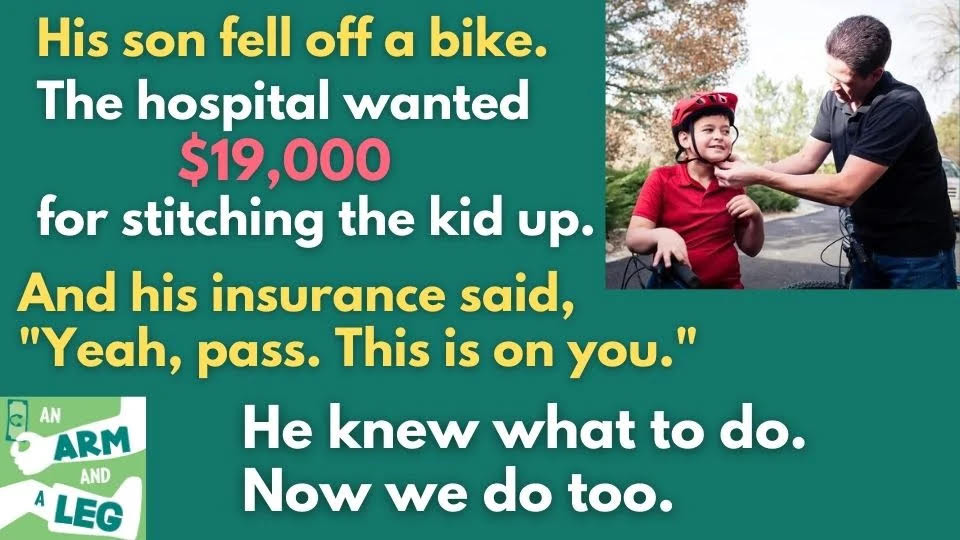
DAN WEISSMANN, BYLINE: One Sunday last July, Adam Woodrum and his wife and their two kids took off on a bike ride around Carson City, Nev., where they live.
ADAM WOODRUM: I’d mapped out kind of a 10-mile route, and we were just going to kind of make a loop of the city.
DAN: But a couple miles in, their 9-year-old son hit a snag.
WOODRUM: We were navigating through some big tree planters, and his handlebar caught. And it just – almost instantaneously, he was on the ground crying, bleeding. And I’m no doctor, but, you know, right away, you can tell that this is a stiches situation.
DAN: At the ER, they actually had to put the poor kid under.
WOODRUM: He was cut in sort of a personal area. Let’s just say that.
DAN: A few weeks later, Adam’s insurance company writes him. The total charges are $19,000, and, they say, you are on the hook for all of it.
WOODRUM: It’s just ridiculous. It’s a ridiculous place to start from.
DAN: And in the fine print, it said, we’re denying this claim, but we could reconsider. Quote, “You will receive an accident questionnaire in a separate mailing,” or you may go to website blah, blah, blah, or call this 800 number or email subrogation-l-n-l-attorneys dot com with any additional questions.
WOODRUM: And it’s clear as mud, right?
DAN: But to Adam, it makes sense. The insurance company is trying to see if there’s a way out of paying this bill. See, Adam’s a personal injury lawyer. Accidents, insurance claims – this is his everyday professional world.
WOODRUM: I mean, this LNL Attorneys – I work with them probably once or twice a month. I have their email addresses. I mean, I know who they are.
DAN: And he knows what subrogation is. For the rest of us, it’s sub, like substitution. The insurance company thinks maybe somebody else should be on the hook for this bill and sub out for them in paying ’cause there’s been an accident.
WOODRUM: It’s basically a contractual right.
DAN: Like, if you were rear-ended, the other driver or their insurance should be responsible. So the health insurance company’s trying to get Adam on the record. What happened? Is there somebody else maybe on the hook? Please sign here. Health insurance companies hire law firms like this LNL outfit in Ohio to make sure you jump through the hoops. The law firm sends out their own letter with the questionnaire. Adam kept an eye out for it, filled it out right away.
WOODRUM: I knew exactly what to expect, and I knew exactly how to handle it because I know how to operate the system. But I, from experience, know that other people do not know how to operate the system.
DAN: Other people like his clients.
WOODRUM: People just simply have no clue what subrogation is or what that – you get a letter from a lawyer in Ohio that says, hey, we need you to come to our website and fill out some paperwork or we’re not going to release your claims to be paid. And you go, well, nuts to you. I don’t have any idea who you are or what this is.
DAN: So people ignore those letters, and their insurance doesn’t pay the medical bills. And they end up in collections. He thought sending in his bill would be a good way to give more of us a heads-up.
****
Man, I love it when insiders come forward to help us out. On the NPR segment, we got the lesson wrapped up for us by Elisabeth Rosenthal, the editor in chief at Kaiser Health News:
ROSENTHAL: While the insurers are duking it out over who will pay, the hospitals and doctors are often sending patients bills and threatening them and maybe even threatening collections.
So I think for patients, the first is our perennial lesson – don’t just pay the bill. Take action. Fill out the forms they send you. Be clear about what happened. This was just a kid who fell off a bike. And let the hospital and doctors know why you’re not paying the bill so they won’t go after you.
Also, if you have to fill out your own claims forms, beware of that little box we often see that says, was this caused by an accident? What that means to an insurer may be, hey, maybe we don’t have to pay, which is not what you’re thinking when you check that box.
Look, I’m not gonna lie: this whole SUBROGATION thing? It’s just one of a million little rules, a million ways the other players could trip you up. We’re not necessarily gonna win by trying to memorize these rules one at a time.
But: There’s a kind of nerdy pleasure in learning what a weird word like SUBROGATION means. And each one of these things does give us LITTLE power back. And it helps us learn the logic of the game.
And I’m learning some bigger lessons that I’m looking forward to sharing with you, when we get back to releasing full episodes this summer. I am so looking forward to it.
Meanwhile, I’ll have another little something for you in the next few weeks.
Till then, take care of yourself.
This episode of An Arm and a Leg was produced by me, Dan Weissmann. Adam Woodrum’s story was originally reported by Julie Appleby for Kaiser Health News, edited for NPR and KHN by Jane Green-halsh and Diane Webber, and by Marian Wang for this release. Daisy Rosario is our consulting managing producer. Adam Raymonda is our audio wizard. Emily Pisacreta is our awesome intern. Our music is by Dave Winer and Blue Dot Sessions.
This season of an arm and a leg is a co production with Kaiser health news. That’s a nonprofit news service about healthcare in America, an editorially independent program of the Kaiser family foundation. Kaiser health news is not affiliated with Kaiser Permanente, the big healthcare outfit. They share an ancestor. This guy, Henry J Kaiser. He had his hands in a lot of different stuff.
He poured concrete— like for the Hoover Dam. Built a chunk of the U.S. cargo fleet for World War II. Made cars. When he died, more than 50 years ago, he left half his money to the foundation that later created Kaiser health news. You can learn more about him and Kaiser health news at arm and a leg show dot com slash Kaiser.
Diane Webber is national editor for broadcast and Taunya English is senior editor for broadcast innovation at Kaiser health news. They are editorial liaisons to this show.
Thanks to Public Narrative — a Chicago-based group that helps journalists and non-profits tell better stories— for serving as our fiscal sponsor, allowing us to accept tax-exempt donations. You can learn more about Public Narrative at www dot public narrative dot org.
And thanks to everyone who is pitching in financially to help get this show made. We could not do it without you. Thank you!